Which Size KitchenAid Bowl Lift Mixer Should You Choose?
For most home bakers, a 5 quart kitchenaid bowl lift mixer is the sweet spot: it handles 9 dozen cookies in one batch and regular bread dough without taking over your counter. Choose a 6 quart model only if you routinely mix double loaves or very large batches.
On this page (10 sections)
- How does bowl lift capacity match your batch size?
- What size kitchenaid bowl lift mixer fits a one loaf batch?
- When should you choose a 6 quart bowl lift mixer?
- How much counter space does a bowl lift mixer need?
- What attachments come in the box and what do they do?
- How do speed settings affect bread, cookies and whipping?
- What is the trade off between KitchenAid Artisan and Cuisinart?
- How do you set up and care for a bowl lift mixer safely?
- What mistakes waste bowl capacity on a kitchenaid bowl lift mixer?
- Which size should you choose for your kitchen?
A 5 quart kitchenaid bowl lift mixer fits most home bakers, because it covers cookies, cakes and one loaf of bread without waste. A 6 quart stand mixer kitchenaid model suits bakers who mix double batches often.
Start with the largest batch you make each month, not the batch you hope to make one day.
Bowl lift capacity matters because the bowl size sets your batch limit. A bowl that is too small forces you to split dough.
A bowl that is too large makes small batches harder to mix well.
We compared specs, bowl sizes and attachments across the models below. We looked at what each bowl holds, what comes in the box and how the lift design changes daily use.
How does bowl lift capacity match your batch size?
Choose bowl size by your biggest routine batch, with room left for ingredients to move. A 5 quart bowl suits 9 dozen cookies at 28g each, as KitchenAid states for its Artisan 5 quart models.
That cookie count uses the flat beater. It shows the bowl can hold a full sheet pan party batch in one go.
For bread, think in loaves. One standard loaf fits a 5 quart bowl with room to knead.
Two loaves need more space.
A 6 quart kitchenaid stand mixer gives about 20 percent more bowl volume than a 5 quart. That extra room helps double loaf batches and large pizza dough.
It can make single batches look sparse, so check the minimum batch guidance for the exact model.
Use this quick rule. If you split dough into two bowls more than once a month, size up.
If you rarely fill the bowl past half, stay smaller.
Our electric stand mixer guide explains how bowl size, speed and attachments work together. Read it first if this is your first stand mixer.
5 quart versus 6 quart in daily use
A 5 quart bowl is easier to store and lift when full. You will use it for most cookies, cakes and one loaf.
A 6 quart bowl saves time on double batches, but it weighs more when full of dough.
Pick 5 quart for weekly baking. Pick 6 quart for weekly double batches.
Pick neither size until you check counter dimensions.
What size kitchenaid bowl lift mixer fits a one loaf batch?
A 5 quart kitchenaid bowl lift mixer fits one loaf of bread, one pizza dough and up to 9 dozen cookies. That makes it the default choice for most kitchens.
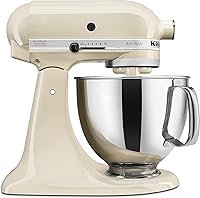
KitchenAid built its Artisan 5 quart models for small or large batches. The 5 quart stainless steel bowl has a comfortable handle and is dishwasher safe.
You get a coated flat beater, coated dough hook, 6-wire whip and pouring shield with the Empire Red model KSM150PS.
The same Artisan line in Almond Cream, model KSM150PSAC, gives you the same 5 quart bowl, 10 speeds and 59 touchpoints around the bowl. Color is the main difference between those two boxes.
Choose 5 quart if you bake for a household, not a bakery. You will store it easily and it will knead one loaf without strain on your schedule.
If you want a deeper look at this line, read our kitchenaid artisan mixer review. It covers the Artisan KSM150 in more detail.
When should you choose a 6 quart bowl lift mixer?
Choose a 6 quart kitchenaid stand mixer when you routinely mix two loaves or a large pizza dough. The extra quart is not just a number.
It gives dough room to fold without riding up the bowl.
Bowl lift designs help here. The bowl rises into the head on arms, so a larger bowl stays locked in place while mixing.
That design suits heavier dough loads than a tilt head of the same bowl size.
Size up if you make sourdough for neighbors, pizza for a crowd or double cookie batches every week. Stay at 5 quart if those batches are rare.
Splitting one batch twice a month costs less than owning a mixer you rarely fill.
Measure your counter and cabinets before you order. Bowl lift models are tall, and the bowl plus head need clear space to operate.
Compare the larger options in our best bowl lift stand mixer roundup. It groups models by bowl size so you can see the jump from 5 quart to 6 quart and beyond.
How to decide if 6 quart is worth it
Ask how often you hit the 5 quart limit. If you hit it weekly, 6 quart will save you time.
If you hit it at holidays only, keep 5 quart and split the holiday batch.
Check attachments that fit the bowl. A larger bowl needs the right beater, hook and whip for that bowl.
Confirm the attachments for the exact model before you buy.
How much counter space does a bowl lift mixer need?
A bowl lift mixer needs more height and depth than its footprint suggests. Measure the spot, then add room to lift the bowl and lock the head.
The Artisan 5 quart models here measure about 14 inches deep and 14 inches high. That is the mixer alone.
You also need space to slide the bowl in from the front and lift it up.
Tape the outline on your counter. Stand where you will use it.
Open cabinet doors above it. If the head hits a cabinet, the mixer will not work in that spot.
Weight matters too. One Artisan model here weighs 23 pounds.
The Cuisinart model below weighs 17 pounds. A heavier mixer is harder to move, so pick a permanent spot.
Place it near an outlet you use often. You do not want to drag it out for every batch.
A fixed spot makes you more likely to use it.
Our stand mixer vs hand mixer guide helps if counter space is tight. It shows when a hand mixer may serve you better.
What attachments come in the box and what do they do?
Attachments decide what you can make. A flat beater, dough hook and wire whip cover almost all home baking.
The exact set in the box matters more than the brand name.
The Empire Red Artisan KSM150PS includes a 5 quart stainless bowl, coated flat beater, coated dough hook, 6-wire whip and pouring shield. The flat beater suits batter and cookies.
The dough hook suits yeast dough. The whip suits egg whites and cream.
The Cuisinart Stand Mixer SM-50BCNAS includes a chef's whisk, dough hook, flat mixing paddle and splash guard with pour spout. It also includes an instruction manual and recipe book.
Cuisinart says the bowl and accessories are dishwasher safe.
Check if hub attachments are sold separately. KitchenAid says its Artisan can use over 10 optional hub powered attachments, sold separately.
Cuisinart lists optional pasta, meat grinder and spiralizer attachments.
Do not assume attachments from one brand fit another. Bowls and beaters are model specific.
If you need a replacement bowl, read our best kitchenaid mixer bowls for stand mixer guide first.
How do speed settings affect bread, cookies and whipping?
Speed settings control texture, not just power. Use low speeds to bring dough together and high speeds to whip air.
The right speed for one task will ruin another.
The Artisan 5 quart models have 10 speeds. KitchenAid says stir speed mixes ingredients together and speed 8 whips cream.
That range covers kneading, mixing and whipping.
The Cuisinart model has 12 speeds and a 500 watt motor. More speeds give you finer control between mixing and whipping.
Cuisinart calls it die cast metal construction, which helps it stay steady.
For dough, start low and add flour gradually. High speed at the start can throw ingredients.
For cookies, cream butter and sugar at medium speed. For whipping, use high speed with the whip until soft peaks form.
Lock the head or bowl before you start. KitchenAid notes you can lock the tilt head in place while mixing.
A bowl lift model locks the bowl to the base or arms.
If you are unsure between tilt head and bowl lift, our best bowl lift stand mixer guide compares lift types by bowl size.
What is the trade off between KitchenAid Artisan and Cuisinart?
The trade off is bowl size, speed count and attachment ecosystem. Both brands here offer 5 quart class bowls with tilt back access and dishwasher safe stainless bowls.
The KitchenAid Artisan 5 quart models offer 10 speeds, 59 touchpoints around the bowl and metal construction built to last, per KitchenAid. The Empire Red model KSM150PSER weighs 23 pounds and measures 14.1 by 8.7 by 13.9 inches.
The Cuisinart SM-50BCNAS offers a 5.5 quart bowl, 12 speeds, a 500 watt motor and die cast metal construction. It weighs 17 pounds and measures 14.17 by 7.87 by 14.13 inches.
Cuisinart backs it with a limited 3 year warranty.
Cuisinart also lists color options including Silver Lining, Onyx, Periwinkle Blue, Ruby Red, White Linen and Robin's Egg. KitchenAid says the Artisan comes in over 20 colors.
Pick KitchenAid Artisan if you want the KitchenAid hub attachment ecosystem. Pick Cuisinart if you want 12 speeds and a 5.5 quart bowl at a lighter weight.
Either bowl fits one loaf and large cookie batches.
See how Cuisinart stacks up in our cuisinart 5.5 quart stand mixer reviews page. It focuses on the Precision Master SM-50 line.
Which one should you pick for dough
Pick the KitchenAid Artisan for dough if you want the coated dough hook and the 59 touchpoint mixing action. Pick the Cuisinart for dough if you want 12 speeds to control the knead more finely.
Both dough hooks are for yeast dough. For stiff dough, use the hook on low speed and stop to check hydration.
No mixer in this size should be forced at high speed with very stiff dough.
How do you set up and care for a bowl lift mixer safely?
Set up the mixer on a flat, dry counter with the bowl locked in place. Locking the bowl prevents it from walking during kneading.
Wipe the base so it does not slide.
Attach the beater, hook or whip fully before you lower or lock the head. KitchenAid notes the attachments secure to the beater shaft with a simple twist.
If it is not seated, it can loosen during mixing.
Add ingredients with the head tilted or the bowl lowered, depending on your model. Tilt head models give you better access to the bowl, per KitchenAid.
Bowl lift models let you slide the bowl out before you lift it.
For care, wash the stainless bowl and attachments as the maker directs. The Artisan 5 quart bowl here is dishwasher safe.
The Cuisinart bowl and accessories are also dishwasher safe, per Cuisinart.
Wipe the mixer body with a damp cloth. Do not submerge the base.
Dry the bowl well after washing to prevent water spots.
If you add hub attachments, check the manual for the hub location and locking steps. KitchenAid and Cuisinart both sell hub attachments separately.
Install them with the mixer off and unplugged.
What mistakes waste bowl capacity on a kitchenaid bowl lift mixer?
The biggest mistake is filling the bowl to the top and starting on high speed. Dough needs room to fold.
Ingredients need room to combine without splashing.
Start on stir or low speed until ingredients form a mass. Add flour a spoonful at a time for bread.
For cookies, add dry ingredients at low speed, then stop and scrape.
A second mistake is using the wrong attachment. The flat beater is for batter and cookies.
The whip is for air. The hook is for yeast dough.
Using the whip for dough can damage it.
A third mistake is ignoring the minimum batch. A very small amount in a large bowl can sit at the bottom and mix poorly.
Use a smaller bowl or a hand mixer for tiny batches.
A fourth mistake is skipping the scrape. Stop the mixer, scrape the bowl with a spatula and restart.
That step gives you even mixing without extra speed.
Our best cuisinart stand mixer accessories guide helps if you plan to add pasta or grinding attachments later. Check fit for your exact model first.
Which size should you choose for your kitchen?
Choose 5 quart for most home bakers and 6 quart for weekly double batches. That rule fits the cookie and bread limits we checked for these models.
If you bake one loaf, a batch of cookies or a cake each week, the 5 quart Artisan covers you. If you bake two loaves, large pizza dough or double batches weekly, the 6 quart bowl lift mixer saves you a second round.
If you want even more room, compare larger bowls in our best 8 quart stand mixer guide. An 8 quart bowl suits commercial scale batches, but it needs a lot of counter and cabinet space.
Measure the spot, check the attachments in the box and confirm the bowl minimum with the maker. Then pick the size you will actually fill.
Start your search with our electric stand mixer buying guide if you are still comparing mixer types. It will help you confirm that a stand mixer, not a hand mixer, fits your baking.
For a final check on the Artisan line, read our kitchenaid artisan mixer review before you order.
Frequently asked questions
What size KitchenAid bowl lift mixer should I buy?
Buy a 5 quart KitchenAid bowl lift mixer for regular cookies, cakes and one loaf of bread. Choose 6 quart if you often mix two loaves, large pizza dough or double batches.
Our score weighs specs, features and buyer feedback against what you are shopping for.
Is a 6 quart KitchenAid stand mixer too big for home use?
A 6 quart KitchenAid stand mixer is not too big if you bake in large batches weekly. It can feel oversized for a single batch of cookies or a small loaf.
Measure your counter and cabinet height first, since bowl lift models are taller and heavier.
Can a 5 quart KitchenAid handle bread dough?
A 5 quart KitchenAid can handle one standard loaf of bread dough and regular pizza dough. KitchenAid says its 5 quart bowl can mix 9 dozen cookies with the flat beater, using 28g dough each.
For two loaves at once, a larger bowl lift model gives you more headroom.
What is the difference between tilt head and bowl lift mixers?
A tilt head mixer lifts the top for access to the bowl. A bowl lift mixer lifts the bowl up into the head on arms, which suits larger bowls and heavier loads.
Compare both styles in our best bowl lift stand mixer guide before you decide.