Stand Mixers: The Complete Buying Guide
An electric stand mixer is the right tool when you mix stiff dough, large cookie batches or whipped egg whites often. A 5 to 5.5 quart tilt head model suits most home kitchens, while larger bowl lift models suit heavy dough work. Pick capacity and head style before you compare brands.
On this page (12 sections)
- What is an electric stand mixer and what does it do best?
- How do tilt head and bowl lift stand mixers differ?
- What bowl capacity do you need for an electric stand mixer?
- What attachments should come in the box?
- How many speeds and how much power do you need?
- Which KitchenAid and Cuisinart examples fit different kitchens?
- How do you choose the right stand mixer for your recipes?
- What are the tradeoffs between smaller and larger stand mixers?
- How do you set up, use and care for a stand mixer?
- What should you check before you buy an electric stand mixer?
- Explore dough mixers by topic
- Which electric stand mixer should you buy in the end?
An electric stand mixer earns its counter space when you mix dough, batter or egg whites more than once a week.
You should compare bowl capacity, head style, speed control and included attachments before you compare colors or brand names.
This guide covers the choices that matter most.
It explains tilt head and bowl lift designs, bowl sizes from 5 quart to 8 quart and larger, and the attachments that change what a mixer can do.
It also compares four concrete examples so you can see how specs translate into daily use.
We compared the machines below by capacity, construction, speed settings and what comes in the box.
You do not need a larger machine for every recipe.
You need the size and design that fit your most common batches.
What is an electric stand mixer and what does it do best?
An electric stand mixer is a countertop machine with a motor, a locked bowl and interchangeable beaters that work while you do other tasks.
It does its best work on stiff dough, large batters and aerated mixtures that need steady beating.
A hand mixer can whip a small bowl of cream.
A stand mixer can hold the bowl still, keep the beater in contact with the sides, and run for several minutes without your hand getting tired. See stand mixer vs hand mixer for help choosing between them.
That steady contact matters for cookie dough, bread dough, cake batter and meringue.
The motor and gearing decide how a mixer handles resistance.
A light batter moves easily at any speed.
A stiff bread dough pushes against the hook and tests the motor on every rotation.
Choose a machine whose capacity and construction match the heaviest dough you plan to make often. For pizza dough, compare pizza dough mixers for home.
KitchenAid describes its Artisan 5 quart model with 10 speeds and a metal build aimed at small or large batches.
Cuisinart describes its 5.5 quart models with a 500 watt motor, die cast metal construction and 12 speeds.
Those specs help you compare power and control without guessing from the name alone.
How do tilt head and bowl lift stand mixers differ?
A tilt head stand mixer tilts the motor head back so you can reach the bowl.
A bowl lift stand mixer keeps the head fixed and raises the bowl into place with a lever or crank.
The head style changes how you add ingredients, scrape the bowl and store the machine.
Tilt head models are common in 4.5 to 5.5 quart sizes.
You tilt the head, add flour or eggs, lower the head and lock it before mixing.
That access helps when a recipe calls for several additions or frequent scraping.
Bowl lift models are common in larger sizes.
The bowl sits on arms and lifts up to lock near the beater.
The fixed head can feel steadier during heavy mixing, and the design pairs well with larger bowls for bread dough and large batches.
If you bake mostly cakes, cookies and whipped cream, a tilt head often feels simpler.
If you make large dough batches often, a bowl lift design deserves a closer look.
You can compare the two styles side by side in our guide to best tilt head stand mixers and our guide to best bowl lift stand mixers.
For KitchenAid shoppers, the KitchenAid bowl lift mixer sizing guide explains how capacity and head style work together in that brand.
Cabinet height also matters.
A tilt head needs clearance when it tips back.
A bowl lift needs clearance for the bowl arms and lever.
Measure the space under your cabinets with the head tilted or the bowl raised before you order.
What bowl capacity do you need for an electric stand mixer?
Most home bakers need a 5 to 5.5 quart bowl. That size handles 9 dozen cookies in one batch in the KitchenAid examples, plus a standard loaf of bread dough or a full cake batter.
A smaller bowl forces you to split batches.
A much larger bowl can feel awkward for a single loaf or a small cake.
Think about your largest normal batch, not your largest dream batch.
Write down the biggest cookie dough, bread dough and cake batter you make most months.
Then choose a bowl that holds that batch with room to spare for the beater to move.
A 5 quart bowl suits single loaves, standard cookie batches and cupcakes.
A 5.5 quart bowl adds a small margin for recipes that spread close to the rim.
An 8 quart bowl suits double batches, larger bread loaves and frequent baking for groups.
If you are torn between neighboring sizes, compare a best 5 quart stand mixer pick with a best 6 quart stand mixer pick and check the bowl dimensions.
A wider bowl can change how the beater reaches the sides.
For double batches, our best 8 quart stand mixer guide shows when that extra room pays off.
For the largest home batches, our best stand mixer large roundup covers the top end of home capacity.
Capacity is not only about volume.
Bowl shape affects how well the beater reaches the bottom and sides.
A tall narrow bowl may leave dough at the base.
A wider bowl may need more ingredients to engage the beater fully.
Check the minimum batch guidance for the model you choose.
What attachments should come in the box?
A useful electric stand mixer includes a flat beater, a wire whip and a dough hook. The flat beater mixes batters and cookie dough.
The wire whip adds air to egg whites and cream.
The dough hook kneads yeast dough.
A pouring shield or splash guard helps you add ingredients without dusting the counter.
Check the exact box contents for each model.
Some mixers include all three beaters.
Some add a pouring shield.
Some leave hub attachments for separate purchase.
The KitchenAid Artisan examples include a coated flat beater, coated dough hook, 6 wire whip and pouring shield.
The Cuisinart examples include a chef whisk, flat mixing paddle, dough hook and splash guard with pour spout, plus an instruction manual and recipe book. For more options, see Cuisinart mixer accessories.
Hub powered attachments expand what a mixer can do.
Optional attachments can include pasta rollers and cutters, pasta extruders, meat grinders, spiralizers and frozen dessert makers.
KitchenAid describes more than 10 optional hub powered attachments, sold separately.
Cuisinart lists pasta extruder, pasta roller and cutters, ice cream maker, meat grinder and spiralizer as optional.
If you plan to use attachments often, check that the model has a power outlet for them.
The Cuisinart models list one power outlet for optional attachments.
KitchenAid models use a hub for optional attachments.
Either system works, but you should confirm the attachment you want fits the model you choose.
Our guide to best stand mixer tools covers attachments and accessories to consider after you choose a base machine.
If you need a second bowl for back to back batches, our best stand mixer replacement bowls guide helps you match size and fit.
How many speeds and how much power do you need?
Ten to 12 speeds give you enough control for most recipes. Low speeds stir ingredients and knead dough.
Mid speeds mix batter.
High speeds whip egg whites and cream.
The exact speed numbers matter less than whether the machine can run steadily at low speed under load.
Low speed control matters for dough.
A mixer that jumps or walks at stir speed will slap dough against the bowl sides.
A steady low speed lets the hook fold the dough without stress.
KitchenAid describes stir speed for mixing ingredients together and speed 8 for whipping cream.
Cuisinart describes 12 speeds for nuance across preparation tasks.
Wattage is only one part of the picture.
Gear design, bowl shape and beater contact also affect performance.
The Cuisinart models list a 500 watt motor with die cast metal construction.
KitchenAid describes 59 touchpoints around the bowl for mixing results.
Both sets of specs point to steady contact between beater and bowl.
Heavy dough work changes the tradeoffs.
If you make pizza dough, bagels or stiff bread weekly, consider a best mixer for bread dough pick or a best heavy duty stand mixer pick.
Those guides focus on machines built to run under sustained resistance.
For home kitchens that mix often but not at commercial volume, a 5 to 5.5 quart machine with 10 or 12 speeds covers the full range.
You do not need the largest motor for cake batter or cookies.
You need smooth speed steps and a bowl that the beater can reach.
Which KitchenAid and Cuisinart examples fit different kitchens?
The KitchenAid Artisan 5 quart and Cuisinart 5.5 quart models suit similar home baking needs with different tradeoffs. Choose between them by bowl size, speed count, included guard style and color, not by brand loyalty alone.
The KitchenAid Artisan in Empire Red is model KSM150PS with a 5 quart stainless steel bowl, 10 speeds and knob controls.
It weighs 23 pounds and measures 14.1 inches deep by 8.7 inches wide by 13.9 inches high.
The bowl has a comfortable handle and is dishwasher safe.
The tilt head locks in place while mixing.
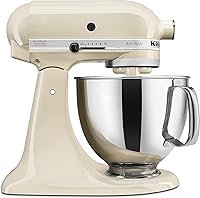
The KitchenAid Artisan in Almond Cream is model KSM150PSAC with the same 5 quart capacity and 10 speeds.
It lists a 1 year hassle free replacement warranty.
The two KitchenAid colors share the same core design, so choose by finish and availability for your kitchen.
The Cuisinart in Silver Lining is model SM-50BCNAS with a 5.5 quart polished stainless steel bowl, 12 speeds, a 500 watt motor and die cast metal construction.
It weighs 17 pounds and measures 14.17 inches deep by 7.87 inches wide by 14.13 inches high.
It includes a chef whisk, dough hook, flat mixing paddle and splash guard with pour spout.
The Cuisinart in Ruby Red is model SM-50RNAS with the same 5.5 quart capacity, 12 speeds and 500 watt motor.
It also weighs 17 pounds.
The Ruby Red and Silver Lining versions differ in color, so pick the finish that fits your counters.
If you want a deeper look at one KitchenAid model, read our KitchenAid Artisan mixer review.
If you want to compare the Cuisinart in detail, read our Cuisinart 5.5 quart stand mixer reviews.
For brand focused shopping, our best KitchenAid stand mixer roundup gathers more options in that line.
A stand mixer with wooden bowl is a separate style choice.
Wood bowls suit serving and display, but they do not replace a stainless steel mixing bowl for heavy dough work.
Most bakers should prioritize a metal bowl that can go in the dishwasher and lock to the base.
How do you choose the right stand mixer for your recipes?
Choose by your most common batch size, your heaviest dough and the attachments you will actually use. Start with the recipes you make monthly.
Then match capacity, head style and box contents to those recipes.
List your top five recipes.
Mark which need a flat beater, which need a whip and which need a dough hook.
Mark which recipes fill a small bowl and which fill a large bowl.
That list tells you your minimum capacity and which beaters must be included.
Next, decide how you add ingredients.
If you add flour in stages and scrape often, a tilt head gives easier access.
If you lock the bowl and let it run, a bowl lift or tilt head with a locking head both work.
The KitchenAid tilt head locks in place while mixing.
The Cuisinart tilt back head gives access to its 5.5 quart bowl.
Then check counter space.
Measure width, depth and height with the head tilted back and the bowl in place.
Check cabinet clearance above the work area.
A mixer that fits on the counter but hits the cabinet when tilted will annoy you every time you use it.
For baking focused choices, our best stand mixers for baking guide narrows the field by recipe type.
If budget matters most, our best stand mixer deals guide shows what to expect at the low end.
If origin matters to you, our best stand mixer made in usa guide covers that angle.
What are the tradeoffs between smaller and larger stand mixers?
Smaller mixers save space and suit single batches. Larger mixers handle double batches and heavy dough with less strain.
Neither size is better for every kitchen.
The right choice depends on batch size and how often you mix.
A 5 quart mixer fits more counters and cabinets than an 8 quart mixer.
It weighs less to move and store.
It suits a single loaf of bread, a standard cookie batch and a full cake batter.
The KitchenAid examples show that 5 quart capacity can hold 9 dozen cookies with the flat beater.
A larger mixer gives you room for double dough batches without splitting the recipe.
It can feel more stable under heavy load.
It also takes more counter space, more cabinet space and more effort to move.
A large bowl can also perform poorly with a small batch if the beater cannot reach the ingredients.
Commercial volume is a different category.
If you run a bakery or cater large events, our best commercial dough mixer guide covers that level.
Home bakers rarely need commercial capacity.
Handle style is a small detail that affects daily use.
A bowl with a comfortable handle, like the KitchenAid 5 quart bowl, makes lifting a full bowl easier.
Our best stand mixer with handle guide covers handled bowls if that detail matters to you.
A best stand mixer cover can protect the machine from dust between uses.
How do you set up, use and care for a stand mixer?
Set up a stand mixer on a flat, stable counter with the bowl locked and the head locked before you start. Run the mixer empty for a few seconds to check for wobble or unusual noise.
Then add ingredients in the order your recipe suggests.
For dough, start on the lowest speed.
Add flour gradually if the recipe allows it.
Let the hook gather the dough before you increase speed.
Stop and scrape the bowl when flour collects on the sides.
Check the dough by touch for smoothness and elasticity rather than relying on the timer alone.
For batter, mix dry ingredients first if your recipe calls for it.
Add wet ingredients with the mixer on low.
Increase speed only after the batter comes together.
Overmixing cake batter can change texture, so follow the recipe timing as a guide.
For whipping, use a clean, dry bowl and whisk.
Egg whites whip best without fat in the bowl.
Cream whips faster when cold.
Watch the mixture closely at high speed because it can move from soft peaks to overbeaten texture quickly.
Care is simple.
Wash the bowl and beaters as the maker directs.
The KitchenAid bowl is dishwasher safe.
The Cuisinart bowl and accessories are dishwasher safe.
Wipe the base with a damp cloth and dry it fully.
Store the cord without tight bends and keep the attachment hub covered if dust collects there.
If your dough work involves pizza, a best dough mixer tool guide covers hand tools that work alongside a stand mixer.
For outdoor baking, compare an electric pizza oven for Neapolitan pizza with a electric or propane pizza oven comparison to see how your dough plans fit your oven choice.
What should you check before you buy an electric stand mixer?
Check capacity, head clearance, box contents and attachment fit before you order. Those four checks prevent most returns.
A mixer that does not fit your cabinets or your recipes will sit unused no matter how strong the motor sounds.
Measure your counter and cabinet space first.
Measure width, depth and height for the machine with the head tilted or the bowl lifted.
Measure the route from delivery to the counter.
A heavy machine that cannot reach its spot is not a good buy.
Confirm the bowl size and shape.
Check whether the bowl locks to the base.
Check whether the bowl has a handle.
Check whether the bowl and beaters are dishwasher safe.
The KitchenAid and Cuisinart examples all list stainless steel bowls, but bowl lock and handle details still differ by model.
Confirm what is in the box.
Look for flat beater, whisk, dough hook and guard.
Check whether hub attachments are included or sold separately.
KitchenAid describes optional hub attachments sold separately.
Cuisinart lists optional attachments for pasta, grinding, spiralizing and frozen desserts.
Decide which attachments you want before you compare total cost.
Confirm speed control and construction.
Look for 10 or more speeds, knob controls and metal construction for frequent use.
The KitchenAid models list zinc or stainless steel materials with 10 speeds.
The Cuisinart models list metal construction with 12 speeds and a 500 watt motor.
Our score weighs specs, features and buyer feedback against what you are shopping for.
Use the product boxes above as examples, then compare other sizes in our related guides.
Explore dough mixers by topic
- Best Stand Mixers with Rotating Bowls
Which electric stand mixer should you buy in the end?
Buy a 5 to 5.5 quart tilt head electric stand mixer for most home kitchens. That size handles cookies, cakes, bread and whipped cream without taking over your counter.
Choose the KitchenAid Artisan for a 5 quart bowl with 10 speeds and a pouring shield.
Choose the Cuisinart 5.5 quart for a slightly larger bowl, 12 speeds and a splash guard with pour spout.
Pick the KitchenAid Artisan in Empire Red or Almond Cream if you want the 5 quart design with the included flat beater, dough hook, wire whip and pouring shield.
Pick the Cuisinart in Silver Lining or Ruby Red if you want the 5.5 quart bowl and 12 speed control.
Size up to a larger bowl lift machine only if you regularly make double batches or heavy dough for a crowd.
Size down only if counter space is very tight and your batches are small.
For most bakers, the middle size does the most work with the least hassle.
Start with the capacity that fits your normal recipes.
Add the beaters you need in the box.
Check head clearance before you order.
That electric stand mixer will serve you well for years of baking.
Frequently asked questions
What size electric stand mixer should I buy first?
Most home bakers should start with a 5 to 5.5 quart electric stand mixer. That size handles a full batch of cookies, a loaf of bread dough or a double cake batter without crowding.
Choose a larger bowl only if you regularly make double dough batches or bake for a crowd.
Is a tilt head or bowl lift stand mixer better?
A tilt head stand mixer gives easier access to the bowl for adding ingredients and scraping sides. A bowl lift stand mixer locks the bowl in place and often pairs with larger capacities for heavy dough.
Choose the head style that matches how you add ingredients and how much counter space you have.
What attachments come with a stand mixer?
Many electric stand mixers include a flat beater for batters, a wire whip for egg whites and cream, and a dough hook for yeast dough. Some models also include a pouring shield or splash guard.
Check the box contents for each model because optional hub attachments are sold separately.
Can a stand mixer knead bread dough?
Yes, an electric stand mixer with a dough hook can knead yeast dough for bread, rolls and pizza. Use the lowest speed, keep the bowl locked, and stop when the dough feels smooth and elastic.
Very stiff or very large dough batches may suit a larger or heavier duty machine.