9 Best Pizza Dough Mixer for Home (November 2026)
The best pizza dough mixer for home include the ZACME 8.4QT Commercial Stand Mixer 800W for large pizza batches, the Kitchen in the box Stand Mixer for small kitchens, and the Kourice 6.5QT Tilt-Head Stand Mixer for family pizza nights.
On this page (10 sections)
- How the best home pizza dough mixer picks compare
- How we compared these pizza dough mixers
- What bowl size does a home pizza dough mixer need?
- Stand mixer or dough maker: which is better for pizza dough?
- How does a dough hook build gluten in pizza dough?
- What speed should you use for pizza dough?
- Can you use a stand mixer for bread dough and other baking?
- How do you set up and care for a pizza dough mixer?
- What to check before you bake with your new mixer
- Verdict: which home pizza dough mixer should you buy?
The best pizza dough mixer for home is the ZACME 8.4QT Commercial Stand Mixer 800W, thanks to its 3 kg maximum dough load and 11 speeds. Choose the Ooni Halo Pro if spiral mixing matters most, and the Kitchen in the box 3.2Qt if your kitchen is small.
Our score weighs specs, features and buyer feedback against what you're shopping for. A pizza dough mixer machine earns its place here by kneading stiff yeast dough without stalling, holding a practical batch, and letting you control speed from the first shaggy mix to the final smooth dough.
Pizza dough is stiff, low hydration and heavy in the bowl. That is why motor power, gear design and the dough hook shape matter more than a long list of cake accessories.
If you are comparing an electric stand mixer for general baking, start with our electric stand mixer guide and then return here for pizza specific batch sizes.
Our picks at a glance
-
1
 Best for large pizza batches
ZACME 8.4QT Commercial Stand Mixer 800W
9.7/10 our score
See it on Amazon -
2

-
3

- 4
 Check it
Nutrimill Bosch Universal Plus Stand Mixer
Best for whole grain dough - 5
 Best for mix and ferment in oneCheck it
- 6Best compact ferment mixerCheck it
- 7
 Best for spiral mixingCheck it
- 8
 Check it
Kitchen in the box Stand Mixer 8.5
Best for heavy dough power - 9
 Check it
YUCHANLUCK Dough Mixer 7.4QT Large Capacity Electric
Best for proofing at home
How the best home pizza dough mixer picks compare
The ZACME leads on maximum dough load, the Kitchen in the box 8.5 leads on wattage, and the Ooni leads on spiral mixing control. The two AIZIYO models and the YUCHANLUCK stand apart because they ferment as well as mix.
Stand mixers versus ferment dough makers
Stand mixers knead with a dough hook and give you speed choice. Ferment dough makers use an S shaped blade and a timed program, then hold a steady proofing temperature.
Both can make pizza dough, but they solve different parts of the job.
ZACME 8.4QT Commercial Stand Mixer 800W: Best for large pizza batches
- 8.4 qt stainless steel bowl
- 800W DC motor
- Maximum dough load 3 kg
- 11 speed settings
- Dough hook, whisk and flat beater
- Tilt head design
A large commercial style mixer that handles up to 3 kg of dough in one bowl, with an 800W motor and 11 speeds for controlled kneading.
Pros
- Largest maximum dough load in this group
- 11 speeds for low kneading and higher mixing
- Stainless steel bowl with dough hook included
Cons
- 33 pounds is heavy to move often
- 18.11 inch depth needs counter space
The ZACME suits pizza lovers who make dough for 4 or more people, or who like to freeze extra dough balls. Its 8.4 qt bowl and 3 kg maximum dough load are the largest in this group, so one batch can cover a full pizza night.
The 800W DC motor, metal gears and 11 speeds give you low settings for bringing dough together and higher settings for smoother mixing. ZACME says first gear noise stays at or below 48 dBA, which helps in an open kitchen.
The tilt head design makes bowl removal and attachment changes easier. The included set covers dough hook, wire whip and flat beater, so you can switch to batter or frosting without buying extras.
Its trade off is size and weight. At 33 lb and 18.11 inches deep, this is a fixed countertop machine, not one you will store in a high cabinet.
If space is tight, a smaller pick below fits better.
Kitchen in the box Stand Mixer: Best for small kitchens
- 3.2 qt stainless steel bowl
- 6 speeds
- 300 watts
- Under 7 lb
- Dough hook, whisk and flat beater
- Tilt head design
A compact 3.2 qt mixer under 7 lb, built for small kitchens and 1 to 2 person pizza batches.
Pros
- Very compact 12.9 x 7 x 10.2 inches
- Lightweight at under 7 lb
- Anti splash lid helps keep flour contained
Cons
- 3.2 qt bowl is small for large batches
- Not suited to handling large mixing loads
This Kitchen in the box model suits singles, couples and small kitchens where a full size mixer will not fit. At under 7 lb and 12.9 x 7 x 10.2 inches, it is the easiest model here to store and move.
The 3.2 qt stainless steel bowl is sized for 1 to 2 pizzas in a typical home batch. Six speeds let you stir on low, mix bread dough or thick batter at mid speeds, and whip cream at higher speeds.
The tilt head and transparent anti splash lid help you add flour or water with less mess. Four anti slip suckers on the base keep the machine steady during operation, which matters on a light unit.
Its trade off is clear. The maker positions this bowl for new bakers and small households, and it is not suited to large batches.
For pizza parties, step up to a 6.5 qt or larger bowl.
Kourice 6.5QT Tilt-Head Stand Mixer: Best for family pizza nights
- 6.5 qt stainless steel bowl
- 10 speeds plus pulse
- 300 watts
- Under 55 dB operation
- Dough hook, whisk and flat beater
- 63 point planetary mixing
A 6.5 qt tilt head mixer with 10 speeds and pulse, sized for family baking, bread and pizza dough.
Pros
- 6.5 qt bowl for family batches
- 10 speeds plus pulse for control
- Splash guard with pouring opening
Cons
- 300 watts is lower than heavy duty picks
- Noise claim is under 55 dB, not silent
The Kourice suits family pizza nights and home bakers who also make bread, cakes and cookies. Its 6.5 qt food grade 304 stainless steel bowl holds a practical family batch without the footprint of an 8 qt machine.
Kourice says operation stays under 55 dB, with a pure copper motor and magnetic levitation bearings. Ten speeds plus pulse give you gentler control when incorporating ingredients, then stronger mixing for thick dough.
The 63 point planetary mixing action rotates the beater around the bowl while it spins on its own axis. That helps distribute ingredients more evenly than a fixed beater path.
Its trade off is power. At 300 watts, it is well suited to home pizza dough, but it does not match the 800W and 900W picks for very stiff or very large loads.
The bowl and dough hook are dishwasher safe, which eases cleanup.
Nutrimill Bosch Universal Plus Stand Mixer: Best for whole grain dough
- 6.5 qt plastic bowl
- 500 watts
- 4 speeds plus pulse
- Bottom drive design
- Dough hook and extender included
- Wire whips included
A bottom drive 6.5 qt mixer with 500 watts and a dough hook extender, built for dense whole grain and bread dough.
Pros
- 500 watts with belt driven torque
- Dough hook extender included
- Lightweight plastic bowl with handle
Cons
- Plastic bowl, not stainless steel
- Only 4 speeds plus pulse
The Nutrimill Bosch Universal Plus suits bakers who make whole grain bread dough, sourdough and large cookie batches as well as pizza dough. Its bottom drive 500W belt driven motor puts torque under the bowl, where the dough is.
The 6.5 qt BPA free plastic bowl is lightweight and has an easy grip handle. Nutrimill says it can knead up to 15 lb of whole grain bread dough, which signals strong low speed torque for dense doughs.
The included dough hook extender helps the hook reach and fold dough through the batch. Wire whips, a lid and a splash ring are included, so whipping and batter work stay covered.
Its trade off is bowl material and speed choice. The bowl is plastic, not stainless steel, and you get 4 speeds plus pulse.
If you want fine speed control for pizza dough, the 10 speed and 58 speed picks offer more range.
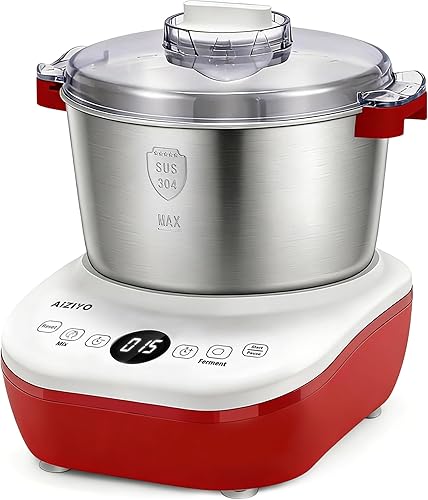
AIZIYO DoughChief: Best for mix and ferment in one
- 7.4 qt 304 stainless steel bowl
- 250 watts
- Ferment function 77 to 100 F
- S shaped mixing blade
- Mix pause mix program
- Touch panel control
A 7.4 qt dough maker that mixes and ferments at 77 to 100 F, with an S shaped blade and mix pause mix program.
Pros
- Mix and ferment in one unit
- 7.4 qt stainless steel bowl
- Wide top opening for adding ingredients
Cons
- 250 watts, lower than stand mixers here
- Single speed program control
The AIZIYO DoughChief 7.4Qt suits home bakers who want mixing and proofing in one machine. Its constant temperature ferment function at 77 to 100 F holds a steady environment for yeast to work.
The S shaped blade uses a mix pause mix program to fold and stretch dough, which simulates hand kneading in cycles. That intermittent motion helps gluten develop without continuous high speed work.
The 7.4 qt 304 stainless steel bowl handles bread, pizza and pasta dough for a family batch. A wide top opening lets you add water or flour while the machine runs, so you can adjust hydration on the fly.
Its trade off is kneading power and control. At 250 watts with program control, it is gentler than an 800W stand mixer.
If you prefer choosing your own speed for stiff pizza dough, a stand mixer gives you that control.
AIZIYO DoughChief: Best compact ferment mixer
- 5.3 qt 304 stainless steel bowl
- Ferment function 77 to 100 F
- S shaped mixing blade
- Touch panel control
- Removable lid
- 9 pounds
A smaller 5.3 qt ferment dough maker at 9 lb, with the same S shaped blade and constant temperature fermenting as the 7.4 qt version.
Pros
- Compact 5.3 qt size for everyday batches
- Lightweight at 9 lb
- Mix and ferment in one unit
Cons
- 5.3 qt limits large pizza party batches
- Requires yeast or fermentation powder for ferment mode
This AIZIYO DoughChief 5.3QT suits smaller households that want fermenting help without a large machine. At 9 lb with a 5.3 qt stainless steel bowl, it is lighter and more compact than the 7.4 qt version.
The same S shaped blade and mix pause mix program fold and stretch dough in cycles. The ferment mode holds 77 to 100 F, so you can mix, proof, or do both in sequence.
Touch panel control and a removable lid keep operation simple. The wide top opening lets you add ingredients while mixing, which helps when you need to correct water or flour.
Its trade off is batch size. A 5.3 qt bowl covers everyday pizza and bread dough, but it will not match an 8 qt bowl for a large gathering.
Like the larger model, it requires yeast or fermentation powder for ferment mode.
Ooni Halo Pro Spiral Mixer: Best for spiral mixing
- 7.3 qt capacity
- 650 watts
- 58 speed settings
- Spiral dough hook
- Rotating bowl
- Four attachments included
A 7.3 qt spiral mixer with 650 watts, 58 speeds from 60 RPM to over 1,000, a rotating bowl and a spiral dough hook.
Pros
- Spiral hook and rotating bowl for gluten development
- 58 speeds for fine control
- Four attachments including breaker bar and geared whisk
Cons
- 14.6 kg is heavy to lift
- 17.2 inch width needs counter space
The Ooni Halo Pro suits pizza makers who care most about dough texture and gluten development. Its spiral dough hook, rotating bowl and removable breaker bar copy the mixing action used in professional kitchens.
With 650 watts and 58 speed settings from 60 RPM to over 1,000, you can fine tune the mix from gentle incorporation to faster finishing. That range helps you stop at a smooth, elastic dough instead of overworking it.
The 7.3 qt stainless steel bowl holds a family sized batch. Four attachments are included, including a flexible beater and geared whisk, so the machine also covers cakes, cookies and whipped cream.
Its trade off is weight and space. At 14.6 kg and 17.2 inches wide, it needs a stable counter and a plan for storage.
Buy it for spiral mixing, not for portability.
Kitchen in the box Stand Mixer 8.5: Best for heavy dough power
- 8.5 qt stainless steel bowl
- 900 watts
- 10 speed control with pulse
- Dough hook, whisk and flat beater
- Tilt head design
- Splash guard included
An 8.5 qt mixer with a 900 watt copper motor and 10 speeds, aimed at heavy dough and family batches.
Pros
- 900 watts, the highest here
- 8.5 qt bowl for family gatherings
- 10 speeds with pulse
Cons
- 16.6 inch width takes counter space
- Large size suits 2 to 6 people, not small kitchens
This Kitchen in the box 8.5QT suits families who make heavy dough often and want maximum wattage. Its 900 watt pure copper motor is the most powerful in this group.
The 8.5 qt stainless steel bowl is aimed at family gatherings and hosting friends. Ten speed control with pulse lets you knead bread and pizza dough on low speeds, blend cake batter at mid speeds, and whip cream at high speeds.
The tilt head design gives access to add ingredients or switch attachments. The dough hook, flat beater, whisk, bowl and splash guard are dishwasher safe, which simplifies cleanup after a large batch.
Its trade off is footprint. At 10.4 x 16.6 x 14.2 inches, it needs full counter depth.
If your kitchen is small, the 3.2 qt model from the same brand fits far better, even though it holds far less dough.
YUCHANLUCK Dough Mixer 7.4QT Large Capacity Electric: Best for proofing at home
- 7.4 qt stainless steel bowl
- 250 watts
- Constant temperature fermentation
- Top small window for adding ingredients
- Touch control
- Digital display
A 7.4 qt dough maker with constant temperature fermentation and a top window for adding water or seasoning while mixing.
Pros
- 7.4 qt bowl for multiple batches
- Constant temperature fermentation
- Top window lets you add ingredients without stopping
Cons
- 250 watts and single speed
- Intermittent mixing design, not continuous kneading
The YUCHANLUCK suits bakers who want a large ferment machine for bread and pizza dough. Its 7.4 qt stainless steel bowl handles multiple batches worth of dough in one run.
Constant temperature fermentation holds an environment for yeast to thrive, which supports consistent rises. A top small window lets you add water, seasoning or other ingredients without stopping the mixer.
The intermittent mixing design lets dough rest during kneading, which helps prevent overheating and premature rising. Touch control and a digital display keep program selection simple.
Its trade off is speed control. At 250 watts with a single speed, you rely on the program rather than choosing your own kneading speed.
If you want manual control, a stand mixer with multiple speeds fits better.
How we compared these pizza dough mixers
We compared specs, features and buyer feedback for each model against pizza dough needs. We looked at bowl size, maximum dough load, motor power, speed range, dough hook design, ferment function, dimensions and weight.
We checked which models include a dough hook, which include only an S shaped blade, and which offer spiral mixing. We also noted dishwasher safe bowls and attachments, splash guards, and whether the head tilts for easy bowl access.
No model here was tested hands on by our team. Scores reflect how well each machine fits a home pizza dough mixer search, from batch size to kneading control to ease of storage.
Why bowl load matters more than bowl volume
Bowl volume tells you how much the bowl can hold, not how much dough it should knead. The ZACME lists a 3 kg maximum dough load, while other makers list capacity without that load limit.
We weighted a stated load more heavily for pizza dough because stiff dough stresses the motor and gears.
What bowl size does a home pizza dough mixer need?
A 3.2 qt bowl suits 1 to 2 people making 1 or 2 pizzas. A 5.3 to 6.5 qt bowl suits most families making 3 to 4 pizzas.
A 7.4 to 8.5 qt bowl suits pizza parties and freezing extra dough.
Small batches: 3.2 to 5.3 quarts
The Kitchen in the box 3.2Qt and the AIZIYO 5.3QT fit small kitchens and small households. They store easily and clean up fast, but they limit how much dough you can make at once.
Family batches: 6.5 to 7.4 quarts
The Kourice 6.5QT, Nutrimill 6.5QT, Ooni 7.3QT and the 7.4 qt ferment models cover most family pizza nights. This range balances batch size with counter space.
Large batches: 8 quarts and up
The ZACME 8.4QT and Kitchen in the box 8.5QT hold the largest loads here. They suit bulk dough, sourdough and hosting, but they need deep counters and storage room.
Stand mixer or dough maker: which is better for pizza dough?
A stand mixer is better if you want speed control and a dough hook. A dough maker with ferment function is better if you want proofing help in the same unit.
Our dough mixer vs bread maker guide breaks down the appliance differences in more detail.
Choose a stand mixer if you knead often
Stand mixers in this group offer 4 to 58 speeds, tilt head access and interchangeable attachments. They also whip, beat and mix batter, so one machine covers more of your kitchen.
Choose a ferment dough maker if proofing is your weak spot
The AIZIYO and YUCHANLUCK models mix and ferment at a steady temperature. That helps beginners and busy bakers, since you set the program and let the machine handle both steps.
How does a dough hook build gluten in pizza dough?
A dough hook stretches and folds dough in the bowl, which aligns gluten strands and builds elasticity. That elasticity lets dough stretch thin for pizza without tearing.
Spiral hooks versus C hooks versus S blades
Spiral hooks, like the Ooni Halo Pro, rotate dough through a consistent path. C shaped hooks, like those on the stand mixers here, pull and fold dough against the bowl.
S shaped blades, like those on the ferment models, fold dough in timed cycles.
Why low speed comes first
Starting on a low speed brings flour and water together without throwing flour around the kitchen. You then raise the speed slowly as the dough forms.
This order protects the motor and gives you a smoother dough.
What speed should you use for pizza dough?
Use the lowest speed to combine ingredients, then move up one or two settings as the dough pulls together. For many stand mixers here, that means speeds 1 to 3 for kneading, with higher speeds reserved for batter and whipping.
How long should you knead?
Knead until the dough looks smooth, pulls away from the bowl sides, and springs back when you press it. The exact time depends on flour, hydration and speed, so judge by appearance and feel, not the clock alone.
Signs you have overworked the dough
Overworked dough feels tight, warm and overly elastic, and it can snap back when you stretch it. If that happens, let the dough rest covered for 20 to 30 minutes before shaping.
The gluten will relax and shaping gets easier.
Can you use a stand mixer for bread dough and other baking?
Yes. Most stand mixers here include a flat beater and whisk for cakes, cookies and frosting.
If you also make a lot of bread, our best mixer for bread dough guide compares models by dough load and hook design.
KitchenAid and other brand specific picks
If you already own a KitchenAid or want to compare it directly, our best kitchenaid dough mixer post covers that brand. Our best stand mixer for dough post ranks stand mixers by dough performance across brands.
Ferment function and proofing
If proofing in the machine appeals to you, our best dough mixer with ferment function post compares ferment models by temperature range and bowl size.
How do you set up and care for a pizza dough mixer?
Place the mixer on a flat, stable counter with room to tilt the head and remove the bowl. Check that the bowl and attachment are locked in place before you add ingredients.
Set up for pizza dough
Add water and yeast first if your recipe calls for it, then add flour, salt and oil in the order your recipe specifies. Start on the lowest speed with the splash guard in place, then increase speed as the dough forms.
Care after each batch
Remove the bowl and attachments and wash them as the maker directs. Many bowls and hooks here are dishwasher safe, but check your model before using the dishwasher.
Wipe the base with a damp cloth and let all parts dry before storage.
Storage and counter space
Measure your counter depth before you order. The ZACME needs 18.11 inches of depth, while the Kitchen in the box 3.2Qt needs only 12.9 inches.
Store light models in a cabinet, and leave heavy models in place if you use them weekly.
What to check before you bake with your new mixer
Once your dough is ready, the next step is a hot oven or pizza oven. Our best pizza oven for home use guide helps you match oven heat to your dough style.
For a steel or stone surface, our best pizza stone for home pizza post compares baking surfaces.
Choose a mixer by your largest usual batch, not your largest possible batch. A bowl that is too large for everyday use gets used less often, and dough that is stretched too thin in an oversized bowl can mix poorly.
Verdict: which home pizza dough mixer should you buy?
Buy the ZACME 8.4QT if you make large batches often. Its 3 kg maximum dough load, 800W motor and 11 speeds make it the strongest all around pizza dough mixer for home in this group.
Choose the Ooni Halo Pro if spiral mixing and fine speed control matter most. Choose the Kitchen in the box 3.2Qt if space is small and you make 1 to 2 pizzas at a time.
Choose the AIZIYO 7.4Qt or YUCHANLUCK 7.4QT if you want fermenting in the same machine. Choose the Kitchen in the box 8.5QT if you want the highest wattage for heavy dough and a large family bowl.
Our top 3 picks at a glance
-
1
Best for large pizza batches
ZACME 8.4QT Commercial Stand Mixer 800W
9.7/10 our score
See it on Amazon -
2
-
3
Frequently asked questions
What is the best pizza dough mixer for home?
For most homes, a 6.5 to 8.4 qt stand mixer with a dough hook gives the best balance of batch size and control. The ZACME 8.4QT leads this group for large batches, while the Ooni Halo Pro leads for spiral mixing.
Match bowl size to your usual pizza count.
Can a stand mixer make pizza dough?
Yes. A stand mixer with a dough hook kneads yeast pizza dough by stretching and folding it in the bowl.
Start on a low speed to bring flour and water together, then increase slowly.
The dough hook does the repetitive work that builds gluten.
What bowl size do I need for pizza dough?
A 3.2 qt bowl suits 1 to 2 people making 1 or 2 pizzas. A 6.5 qt bowl suits family batches of 3 to 4 pizzas.
An 8 qt or larger bowl suits pizza parties and freezing extra dough balls.
Check the maximum dough load, not just bowl volume.
Is a dough maker with ferment function better than a stand mixer?
A ferment dough maker adds proofing in the same unit, which helps beginners get consistent rises. A stand mixer gives more speed control and stronger kneading for stiff doughs.
Choose based on whether proofing help or kneading control matters more to you.


