9 Best Marble Pastry Boards (November 2026)
The best marble pastry boards for dough include the Thirteen Chefs 18 x 18 Inch Square Marble for large pie crusts, the Kota Japan White Marble Dough Rolling for small counters, and the Fox Run Marble Pastry Board for serving and baking.
On this page (9 sections)
- The best marble pastry boards for rolling dough
- How the best marble pastry board compares on size, weight and cooling
- How we compared these marble pastry boards
- What size marble pastry board should you choose?
- Marble pastry board vs wooden pastry board: which is better for dough?
- How do you use a marble pastry board for rolling dough?
- How do you clean and care for a marble pastry board?
- What are the downsides of a marble pastry board?
- Verdict: which marble pastry board should you buy?
The best marble pastry board for most bakers is the Thirteen Chefs 18 x 18 Inch Square Marble, because its large square surface and cool stone help you roll butter dough without it softening. Our score weighs specs, features and buyer feedback against what you are shopping for.
A marble pastry board works differently from a wooden board. Marble provides a cool work surface for rolling and handling dough, so butter stays firmer while you roll, fold and shape.
That cooling effect matters most for pie crust, puff pastry, cookies and pizza dough. Warm dough sticks more and tears more easily, while a chilled marble surface helps you work with less flour.
We compared nine marble pastry boards by size, thickness, weight, feet and intended use. We checked the specs for each board and looked at how the surface is meant to be used, including whether it is for rolling only or also for serving.
Our picks at a glance
-
1
 Best for large pie crusts
Thirteen Chefs 18 x 18 Inch Square Marble
9.7/10 our score
See it on Amazon -
2

-
3
- 4
 Check it
Kota Japan Premium Non-Stick Natural Black Granite
Best granite alternative - 5
 Check it
Adolif Carrara White Marble Cutting Board
Best for pizza dough - 6
 Best large marble slabCheck it
- 7
 Check it
KC KULLICRAFT Marble Pastry & Cutting Board
Best light marble board - 8
 Check it
Koville Italian Carrara Marble Cutting Board
Best for gifting - 9
 Check it
Lovdeco Carrara Marble Cutting Board 20x16 Inch
Best thick large board
The best marble pastry boards for rolling dough
Each board below is a stone slab, not a wooden cutting board. Use the size and weight to decide which one fits your counter and your lifting limit.
Thirteen Chefs 18 x 18 Inch Square Marble: Best for large pie crusts
- 18 x 18 in square marble
- 3/4 in thick
- 6 non-slip rubber feet
- Stays below room temperature
An extra large square marble board with raised feet for rolling pie dough, pastry and pizza dough.
Pros
- Extra large 18 x 18 in surface
- Six raised non-slip feet
- Stays cool for butter dough
Cons
- Very heavy at about 25 lb
- Square shape uses more counter space
This Thirteen Chefs board suits bakers who roll large pie crusts and want a square surface that does not feel crowded. At 18 x 18 in and 3/4 in thick, it gives you room to turn dough while you roll.
Its weight is listed at 24.1 lb, and the title describes it as about 25 lb. That weight keeps the board steady, but it also means you should plan where it will live so lifting it is not part of daily cleanup.
Six raised non-slip rubber feet hold it in place and protect the counter. Thirteen Chefs says real marble stays below room temperature, which helps keep butter dough cool while you work.
The smooth polished surface does not absorb odors, moisture or fats, according to Thirteen Chefs. That helps with chocolate work as well as pastry, because a cool surface can help chocolate set.
The square layout also suits round doughs, since you can rotate the crust in any direction without reaching a short edge. The 3/4 in thickness helps the slab retain its cool temperature during a longer rolling session.
The trade-off is storage and movement. This is a board you set down for a session and leave out or slide into a low cabinet, rather than one you move in and out for quick jobs.
Against the smaller boards here, it offers the most workspace at the highest lifting cost.
Kota Japan White Marble Dough Rolling: Best for small counters
- 15.75 x 11.75 in marble
- Non-slip rubber feet
- Chill 15-30 minutes before use
- Not for knife cutting
A midsize white marble rolling slab that stays cool for pastry, cookie and pizza dough.
Pros
- Manageable 11.4 lb weight
- Cool surface for rolling
- Feet protect countertops
Cons
- Smaller than 16 x 20 in boards
- Not a knife cutting board
This Kota Japan board suits home bakers with a midsize counter who want a cool rolling surface without a very heavy slab. It measures 15.75 x 11.75 in and weighs 11.4 lb.
That smaller footprint is easier to lift, wash and store than a 16 x 20 in board. It still gives you enough room for pastry, cookie and pizza dough for a small batch.
Kota Japan says to chill the slab for 15 to 30 minutes before rolling for best results. The cool surface helps keep dough from sticking or softening while you roll.
Non-slip rubber feet keep it steady and protect countertops. The board is described as a pastry and serving slab, not an everyday knife cutting board, so use it for rolling and display rather than chopping.
Each slab has natural veining, so no two look exactly alike. That makes it work as a cheese or charcuterie board when you are not baking.
The 0.5 in thickness keeps the slab lighter at 11.4 lb, which makes daily pickup and hand washing more realistic than with the 22 lb options. It is a practical middle ground for a person who bakes weekly rather than daily.
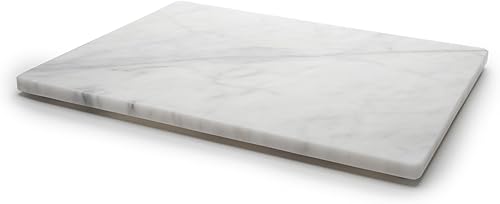
Fox Run Marble Pastry Board: Best for serving and baking
- 16 x 20 in natural white marble
- 0.75 in thick
- 22.2 lb
- Non-slip rubber feet
A large 16 x 20 in marble board for rolling dough and serving cheese or charcuterie.
Pros
- Large rectangular surface
- Doubles as serving board
- Naturally cool and smooth
Cons
- Heavy to lift and store
- Needs a large counter area
This Fox Run board suits bakers who want one large board for dough work and serving. It measures 16 x 20 x 0.75 in and weighs 22.2 lb.
The rectangular shape gives you a long rolling area for pie crust, biscuits, tarts and pizza dough. It also works for appetizers, sandwiches and cheese display.
Fox Run says professional bakers prefer marble for its naturally cool temperature and no-stick properties. The cool, smooth surface helps with rolling and makes cleanup simpler.
Non-slip rubber feet hold the board in place while you roll and fold. The feet also protect your countertop from scratches.
The polished finish and natural pattern mean each board looks a little different, which helps it sit comfortably on a dining table as well as in the kitchen. The specs list recommended uses that include bread, charcuterie, cheese, dough and pastry.
The trade-off is weight and space. At 22.2 lb, you need a clear plan for lifting and storing it.
Measure your counter first, because a 16 x 20 in board takes up a full work zone, and compare it with the lighter Kota Japan slab if space is tight.
Kota Japan Premium Non-Stick Natural Black Granite: Best granite alternative
- 15.75 x 11.75 in black granite
- Non-slip rubber feet
- Stays cool for dough rolling
- Not for knife cutting
A black granite pastry slab with the same cool rolling surface concept as marble.
Pros
- Cool granite surface
- Midsize footprint
- Dark color hides flour marks
Cons
- Granite, not marble
- Not a knife cutting board
This Kota Japan board suits bakers who like the cool rolling concept but prefer black granite to white marble. It measures 15.75 x 11.75 x 0.5 in and weighs 12.3 lb.
Granite stays cool in the same way marble does, according to Kota Japan. Chill it for 15 to 30 minutes before rolling pastry, cookie or pizza dough.
The midsize surface gives you room to roll without crowding a small counter. Non-slip rubber feet keep it steady and protect countertops.
Kota Japan describes this as a cold rolling surface, not an everyday knife cutting board. Avoid cutting directly on it to keep the surface smooth.
The dark black color suits farmhouse, rustic or contemporary kitchens, according to Kota Japan. It also tends to hide flour marks better than a white board while you work.
At 12.3 lb, it is only a little heavier than the white Kota Japan marble at 11.4 lb, so the choice here is mostly about color and material preference. The granite pattern is also one of a kind, so it can double as a serving piece for cheese or charcuterie after baking.
Adolif Carrara White Marble Cutting Board: Best for pizza dough
- 12 x 16 in Carrara white marble
- 0.5 in thick
- About 11 lb
- Non-slip feet and beveled edges
A 12 x 16 in Carrara marble board for stretching pizza dough, bread dough and pastry.
Pros
- Compact 12 x 16 in size
- Beveled edges and rounded corners
- Stays cool for dough
Cons
- Smaller rolling area
- Acids can damage marble
This Adolif board suits pizza makers and bread bakers who want a compact marble surface. It measures 12 x 16 x 0.5 in and weighs about 11 lb.
That size gives you ample space to stretch pizza dough for a home pizza, according to Adolif. It also works for bread dough, pie crust and pastry in a normal home kitchen.
The board stays cooler than room temperature, which helps keep dough firm and butter intact. Adolif also lists chocolate tempering as a suitable use.
Non-slip feet prevent slipping and protect your desktop. Beveled edges and rounded corners give you a smoother grip when you move the board.
Adolif describes the marble as dense and hard, resistant to cracking or warping, with low water absorption and a polished surface that resists stains and odors. That means after rolling, a rinse and wipe should be enough, with no oiling required.
The trade-off is rolling area. At 12 x 16 in, it is smaller than the 16 x 20 in boards, so large pie crusts will feel tighter here.
For pizza and bread dough in a smaller kitchen, that balance of space and 11 lb weight is often the better daily fit.
Adolif Marble Cutting Board: Best large marble slab
- 16 x 20 in marble
- 0.7 in thick
- 22 lb
- Non-slip feet
A large 16 x 20 in natural marble slab for rolling, stretching and serving.
Pros
- Large 16 x 20 in surface
- Heavy and stable
- Beveled edges
Cons
- Heavy at 22 lb
- Acids can damage marble
This Adolif board suits bakers who want a large marble slab for rolling and stretching. It measures 16 x 20 x 0.7 in and weighs 22 lb.
The large surface gives you room for pizza dough, bread dough and pastry without crowding. Its weight helps it stay put while you work.
Adolif says the board is 100% natural marble with a dense, hard structure. Each piece has unique veining, so the look will differ from another board.
Non-slip feet help prevent slipping and protect your desktop. Beveled edges and rounded corners make handling safer.
The board stays cooler than room temperature, which helps keep dough firm and butter intact. Adolif lists cake, pie, pizza and candy work as suitable uses.
The low water absorption and polished surface mean it can be rinsed and wiped clean without special cleaners, according to Adolif. The color listed is white with gold veining, which gives it a different look from plain Carrara white options.
The trade-off is lifting and care. At 22 lb, it is not a board to move casually.
Clean acidic foods promptly and hand wash only, since Adolif warns that acids can corrode natural marble.
KC KULLICRAFT Marble Pastry & Cutting Board: Best light marble board
- 10 x 14 in Carrara marble
- 0.5 in thick
- 7.7 lb
- Non-slip rubber feet
A light 10 x 14 in marble board for small pastry work, cheese and serving.
Pros
- Lightest board here at 7.7 lb
- Compact storage
- Cool smooth surface
Cons
- Smallest rolling surface
- Not for heavy chopping
This KC KULLICRAFT board suits bakers who want the lightest marble option here. It measures 10 x 14 in and weighs 7.7 lb.
At 7.7 lb, it is easier to lift, store and wash than the 22 lb boards. That makes it a good choice if you have limited strength or a small storage space.
The 10 x 14 in surface is best for small pastry work, cheese slicing and serving. It is not the best choice for rolling a large pie crust, because the surface fills up quickly.
The board is made from genuine Carrara marble with a polished finish. Marble stays cooler than room temperature, which helps with pastry dough, pizza dough and chocolate.
Non-slip rubber feet keep it in place on a smooth, flat surface. KC KULLICRAFT says it is designed for light to moderate prep, not heavy chopping.
The hand polished Carrara surface has natural veining, so each piece is one of a kind, and the solid marble will not warp like a thin board. The specs also list uses that include bread, cheese, fish, fruit and pastry.
Against the larger boards, this one trades rolling room for portability. If you mainly make small batches, cookies or serving boards, the 7.7 lb weight may be worth more than extra inches.
Koville Italian Carrara Marble Cutting Board: Best for gifting
- 16 x 20 in Italian Carrara marble
- 0.6 in thick
- Non-slip feet
- Non-porous surface
A large Italian Carrara marble board for pastry, cheese and charcuterie display.
Pros
- Large 16 x 20 in surface
- Unique natural veining
- Non-stick rolling surface
Cons
- Weight not stated
- Needs care with oily foods
This Koville board suits bakers who want a large Italian Carrara marble board for pastry and display. It measures 16 x 20 in and is 0.6 in thick.
The large rectangular surface gives you room to roll dough, pastries and fondant. Koville says the non-stick surface helps with rolling with a minimal amount of flour.
The marble is Italian Bianco Carrara with a white base and gray texture. Each piece is unique because of the natural distribution of stone crystals.
Non-slip feet hold the board in place during prep. The board also works for chocolate tempering and serving cheese, according to Koville.
Koville says the surface is non-porous and easy to clean with hot water and soap. It also warns to take care with oily or colored foods because of the natural porous character of marble.
The recommended uses listed are cheese and charcuterie, which points to its strength as a display and serving slab as well as a rolling surface. The gray veining described as flowing like a river gives it a softer look than stark white marble.
The main trade-off is that weight is not stated, so you cannot compare lifting effort directly with the 22 lb boards. If gifting or presentation matters most, that unique pattern may outweigh the missing weight detail.
Lovdeco Carrara Marble Cutting Board 20x16 Inch: Best thick large board
- 16 x 20 in Carrara marble
- 0.75 in thick
- Non-slip rubber feet
- Beveled edge
A thick 16 x 20 in marble pastry board for dough work and kitchen display.
Pros
- Thick 0.75 in slab
- Large flat surface
- Non-slip feet
Cons
- Heavy at about 24 lb
- Large footprint
This Lovdeco board suits bakers who want a thick, large marble slab. It measures 16 x 20 x 0.75 in and weighs about 24 lb.
Thickness matters because a thick slab holds its cool temperature longer while you work. The large flat, hard surface also works for cutting, slicing and slicing cheese, fish and vegetables.
The cooler surface is ideal for working with chocolate, pizza dough or cookie dough, according to Lovdeco. It can also cool hot tarts and pies.
Non-slip rubber feet protect your countertops and tabletops against scratching. A beveled edge and hand-made rounded corners make handling safer.
The surface finish is polished and the bottom is honed, according to the product description. That combination gives a smooth rolling top with a less finished underside.
At 0.75 in thick, it matches the Fox Run board for thickness and is thicker than the 0.5 in Kota Japan and Adolif compact boards, so it should stay cool through a longer session.
The trade-off is weight and footprint. At about 24 lb, this board needs a fixed spot on your counter or a low cabinet where you can slide it in and out.
It is best for a baker who will leave it in place rather than move it for each use.
How the best marble pastry board compares on size, weight and cooling
The best marble pastry board depends on three things: how much counter space you have, how heavy a board you can lift, and how often you roll butter dough. Size, weight and cooling decide the fit.
| Board | Size | Weight | Best fit |
|---|---|---|---|
| Thirteen Chefs | 18 x 18 in | 24.1 lb | Large pie crusts |
| Kota Japan White Marble | 15.75 x 11.75 in | 11.4 lb | Small counters |
| Fox Run | 16 x 20 in | 22.2 lb | Baking and serving |
| Kota Japan Black Granite | 15.75 x 11.75 in | 12.3 lb | Granite alternative |
| Adolif Carrara White | 12 x 16 in | 11 lb | Pizza dough |
| Adolif Marble | 16 x 20 in | 22 lb | Large slab |
| KC KULLICRAFT | 10 x 14 in | 7.7 lb | Light board |
| Koville Italian Carrara | 16 x 20 in | Not stated | Gifting |
| Lovdeco Carrara | 16 x 20 in | 24.1 lb | Thick slab |
| Product | Best for | Size | Thickness | Weight | Our score |
|---|---|---|---|---|---|
| Thirteen Chefs 18 x 18 Inch Square Marble | large pie crusts | 18 x 18 in | 0.75 in | 24.1 lb | 9.7 |
| Kota Japan White Marble Dough Rolling | small counters | 15.75 x 11.75 in | 0.5 in | 11.4 lb | 9.6 |
| Fox Run Marble Pastry Board | serving and baking | 16 x 20 in | 0.75 in | 22.2 lb | 9.3 |
| Kota Japan Premium Non-Stick Natural Black Granite | granite alternative | 15.75 x 11.75 in | 0.5 in | 12.3 lb | 9.1 |
| Adolif Carrara White Marble Cutting Board | pizza dough | 12 x 16 in | 0.5 in | 11 lb | 8.9 |
| Adolif Marble Cutting Board | large marble slab | 16 x 20 in | 0.7 in | 22 lb | 8.7 |
| KC KULLICRAFT Marble Pastry & Cutting Board | light marble board | 10 x 14 in | 0.5 in | 7.7 lb | 8.4 |
| Koville Italian Carrara Marble Cutting Board | gifting | 16 x 20 in | 0.6 in | Not stated | 8.2 |
| Lovdeco Carrara Marble Cutting Board 20x16 Inch | thick large board | 16 x 20 in | 0.75 in | 24.1 lb | 8.0 |
How we compared these marble pastry boards
We compared the specs for size, thickness, weight, material and feet. We also checked what each board is meant for, such as rolling dough, serving cheese or both.
We did not test these boards. Our scores weigh the specs and features against what a pastry board searcher needs: a cool surface, a stable base and enough room to roll.
Weight played a big role in the ranking. A 22 lb board stays put, but it is harder to move.
A 7.7 lb board is easier to handle, but it has a smaller rolling area.
We also looked at care. Most of these boards are hand wash only, and several makers warn about acidic foods.
That matters if you plan to use the board for cheese, tomato or citrus.
Thickness and feet in the specs
Thickness ranges from 0.5 in on the compact boards to 0.75 in on the Thirteen Chefs, Fox Run and Lovdeco boards. Thicker stone should hold a cool temperature longer, while thinner stone is easier to lift.
Feet matter for both stability and counter protection. Boards with non-slip rubber feet, including the Thirteen Chefs model with six raised feet, are less likely to shift while you roll.
That detail is worth checking if your countertop is smooth stone or laminate.
What size marble pastry board should you choose?
A 16 x 20 in board is the safest all-around size for most kitchens. It gives you room to roll pie crust and pizza dough without crowding.
Choose 12 x 16 in if your counter is small. The Adolif Carrara White board at 12 x 16 in and about 11 lb is easier to lift and store.
Choose 18 x 18 in if you roll large crusts often. The Thirteen Chefs board gives you a square surface that lets you turn dough as you roll.
10 x 14 in and smaller
The KC KULLICRAFT at 10 x 14 in is the smallest here. It works for small pastry work and serving, not for large pizza dough.
12 x 16 in
A 12 x 16 in board, such as the Adolif Carrara White model, balances space and weight. It is a good pick for pizza dough and bread dough in a compact kitchen.
16 x 20 in
A 16 x 20 in board, such as the Fox Run or Adolif Marble models, gives you the most rectangular rolling room. It needs a large counter and a storage plan.
18 x 18 in
The Thirteen Chefs at 18 x 18 in is the largest square option. It suits pie crust work where you need room to turn and shape dough.
If you want help choosing between sizes, our guide to a marble pastry board 24 x 16 breaks down how footprint affects rolling space.
Marble pastry board vs wooden pastry board: which is better for dough?
A marble pastry board is better for butter dough that softens fast. Marble stays cool, so pie crust and puff pastry stay firmer while you roll.
A wooden pastry board is better if you want a lighter board that you can also use for chopping. Wood is warmer, lighter and easier to store.
Wood is also easier on knives. Marble is not meant for everyday knife cutting, and several makers here say to avoid cutting directly on the surface.
If you are torn, read our guide to the best wooden pastry boards for dough to compare weight and care. You can also check the best wooden pastry board with lip if you want a rim to keep flour and dough scraps in place.
How do you use a marble pastry board for rolling dough?
Start by chilling the board. Kota Japan says to chill the slab for 15 to 30 minutes before rolling pastry, cookie or pizza dough.
Use a light dusting of flour if you need it. Marble is smooth and non-stick, but sticky dough can still need a little flour at the edges.
Roll from the center out, then turn the dough a quarter turn and roll again. The cool surface helps keep the dough from sticking as you turn it.
For pizza dough, stretch it on the board and let it rest if it springs back. The cool surface helps the dough stay firm while you shape it.
For chocolate, a cool marble surface helps chocolate cool quickly. This is why bakers and chocolatiers value marble for tempering work.
After rolling, move the dough to a pan or tray. Then wipe the board clean while it is still at room temperature.
How do you clean and care for a marble pastry board?
Hand wash with warm water and mild soap, then dry it thoroughly. Most boards here list hand wash only as the care instruction.
Do not put a marble board in the dishwasher. Heat and detergent can damage the polished finish over time.
Clean acidic foods off as soon as possible. Adolif warns that acids can corrode natural marble, so do not leave tomato sauce, citrus or vinegar sitting on it.
Avoid soaking the board. Marble is non-porous when polished, but prolonged soaking is not needed and can stress the stone.
Store it flat or upright in a spot where it will not chip. Stone can chip if it falls, so keep it away from edges where it can slide off.
If you also proof dough on a board, a dough proofing container can help you keep dough organized while the board is free for the next batch.
What are the downsides of a marble pastry board?
Weight is the biggest downside. Most boards here weigh 11 to 24 lb, and the largest ones are hard to move daily.
Marble is also brittle compared with wood. It can chip or crack if it falls on a hard floor.
Acids can damage marble. Lemon, tomato and vinegar can etch the polished surface if you leave them on it.
Marble is not a knife cutting board. Use it for rolling, serving and cooling, not for heavy chopping.
Finally, marble needs counter space. A 16 x 20 in board takes up a full work zone, so measure before you buy.
Verdict: which marble pastry board should you buy?
Buy the Thirteen Chefs 18 x 18 Inch Square Marble if you roll large pie crusts often. Its 18 x 18 in surface, 3/4 in thickness and cool stone give you the most room to work.
Buy the Kota Japan White Marble Dough Rolling if counter space is tight. Its 15.75 x 11.75 in size and 11.4 lb weight are easier to handle while still keeping dough cool.
Buy the KC KULLICRAFT if lifting weight is your main concern. At 7.7 lb and 10 x 14 in, it is the lightest and smallest board here, best for small pastry work.
Measure your counter, check your storage spot, and pick the size you can lift without strain. That choice matters more than the veining pattern on any marble pastry board.
Our top 3 picks at a glance
-
1
Best for large pie crusts
Thirteen Chefs 18 x 18 Inch Square Marble
9.7/10 our score
See it on Amazon -
2
-
3
Frequently asked questions
What is the best marble pastry board size for most people?
A 16 x 20 in board gives room to roll pie crusts and pizza dough without crowding. Choose 12 x 16 in if your counter is small, and 18 x 18 in if you roll large crusts often.
Can you cut on a marble pastry board?
Most marble pastry boards here are for rolling and serving, not everyday knife cutting. Cutting directly on the surface can dull knives and scratch the polished finish.
How do you keep a marble pastry board cool for dough?
Chill the board for 15 to 30 minutes before rolling pastry, cookie or pizza dough. Marble stays below room temperature, which helps keep butter firm while you work.
How do you clean a marble pastry board?
Hand wash with warm water and mild soap, then dry it thoroughly. Avoid soaking, dishwashers and long contact with acidic foods, which can damage natural marble.