8 Best Bread Proofing Mats (November 2026)
The best bread proofing mats include the Cozy Bread® Sourdough Bread Proofing Mat for most home bakers, the Yendse Sourdough Heating Mat Dough Proofing Box for wide temperature range, and the Cozy Bread® Proofing Box (best insulated box for the cozy mat).
On this page (9 sections)
- Our top bread proofing mats by score
- How the best bread proofing mats compare
- What size bread proofing mat do you need?
- What temperature range matters for a sourdough bread proofing mat?
- Do you need a timer or sensor on your bread proofing mats?
- Should you buy a proofing box, a cover or just a mat?
- How do you set up and care for a bread proofing mat?
- When is a proofing mat not enough?
- Our verdict on the best bread proofing mat
The best bread proofing mat for most home bakers is the Cozy Bread Sourdough Bread Proofing Mat, thanks to its fine temperature steps and compact size. A proofing mat for bread gives you steady warmth on a cold counter so dough rises on schedule instead of waiting for a warm room.
Our score weighs specs, features and buyer feedback against what you are shopping for. We compared temperature range, size, timers, sensors, covers and ease of storage across these eight picks.
If your dough tears during shaping, read why pizza dough tears before proofing before you change your proofing setup. Weak gluten or dry dough needs a recipe fix, not more heat.
Our picks at a glance
-
1
 Best for most home bakers
Cozy Bread® Sourdough Bread Proofing Mat
9.7/10 our score
See it on Amazon -
2
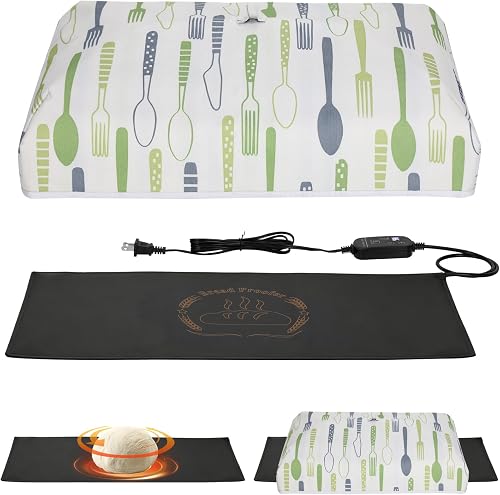 Best for wide temperature range
Yendse Sourdough Heating Mat Dough Proofing Box
9.6/10 our score
See it on Amazon -
3

- 4
 Best simple three setting matCheck it
- 5
 Check it
Dougvera Bread Proofing Mat 13 x 21In
Best for timer and overnight proofing - 6
 Best for sensor based proofingCheck it
- 7
 Check it
sproerden Sourdough Starter Warmer Mat
Best for starter jars - 8
 Check it
EKEPIN Dough Proofing Heat Mat with Cover
Best mat with cover bundle
Our top bread proofing mats by score
The top three cover most kitchens. The Cozy Bread mat is the all round pick, the Yendse gives the widest range and the Cozy Bread box adds insulation when you pair it with its matching mat.
Cozy Bread® Sourdough Bread Proofing Mat: Best for most home bakers
- Thermostat controlled 70 to 122 F in 1 F steps
- 10 x 21 in compact mat
- Fast 1 to 2 minute preheat
- Silicone, hand wash only
A compact thermostat mat that fits under bowls, starter jars and the matching Cozy Bread proofing box.
Pros
- Fine temperature steps
- Quick preheat
- Stores flat and light
Cons
- Mat only, box sold separately
- No timer stated
This mat suits home bakers who proof sourdough, pizza dough, rolls and enriched doughs on the same counter. The 70 to 122 F range in 1 F steps lets you set a precise target for a starter or a bulk ferment.
The 10 by 21 in size fits under bowls, starter jars, proofing containers and insulation boxes. That footprint stores flat in a drawer or cabinet when you do not need heat.
Cozy Bread says the mat preheats in 1 to 2 minutes. That speed matters for feeding a starter or starting a final proof without waiting for an oven to warm.
The trade off is that this is a mat only. If you want an insulated enclosure, you need the separate Cozy Bread proofing box lower in this guide.
Yendse Sourdough Heating Mat Dough Proofing Box: Best for wide temperature range
- 59 to 140 F adjustable range
- 10 x 20.7 in surface
- 0.75 lb and water resistant
- Defaults to 89 F
A broad range mat that suits dough, yogurt, fruit wine and food warming at higher settings.
Pros
- Widest range here at top end
- Light and portable
- Wipes clean
Cons
- Do not fold for storage
- Not for wooden or flammable surfaces
Yendse suits bakers who want one mat for dough, yogurt, fruit wine and warming food. Its 59 to 140 F range is the widest top end in this group.
The surface measures 10 by 20.7 in and weighs 0.75 lb. That light weight makes it easy to move between a counter, a proofing spot and storage.
The mat defaults to 89 F. You will need to raise the setting for food warming jobs that need more heat.
Yendse says to preheat on a long towel for 15 minutes, then set the bowl on the mat and cover the dough with the towel. A towel cover is a simple way to hold humidity.
The trade offs are storage and placement. Yendse says not to fold the mat and not to place it on wooden tables or flammable materials.
Cozy Bread® Proofing Box: Best insulated box for the Cozy mat
- 10 x 21 x 9 in insulated box
- Compatible with 10 x 21 in mat
- Heat mat not included
- Vented, BPA free
An insulated box that pairs with the 10 by 21 in Cozy Bread mat to hold heat around dough.
Pros
- Made to match the Cozy mat size
- Insulated walls
- Compact and portable
Cons
- Heat mat not included
- Box only, not a warmer on its own
This box suits bakers who already own or plan to buy a 10 by 21 in heat mat. It is an insulated box made to match that mat size, not a heater by itself.
The box measures 10 by 21 by 9 in. That height gives room for a bowl or a loaf pan while the insulated walls hold warmth around it.
Cozy Bread says the box works with any 10 by 21 in sourdough warmer. A vented design and smooth interior make daily wiping and storage simpler.
The key limit is in the name. The heat mat is not included, so budget for both pieces if you want the full warmer and box set.
Use the box when a mat alone loses too much heat through the sides of a bowl. Use a mat alone when you proof in a covered bowl and want the smallest setup.
Hemli Home Bread Proofing Mat: Best simple three setting mat
- Low, medium and high heat settings
- 120 V North American use
- 30 cm round design
- Low wattage heating
A simple round mat with three set heat levels for bakers who do not want number controls.
Pros
- Simple L, M, H controls
- Round shape suits a bowl
- Low energy use
Cons
- No exact temperature numbers
- Round shape wastes space for loaf pans
Hemli Home suits bakers who want simple controls. The mat uses three heat settings, Low, Medium and High, instead of a number display.
That setup fits a routine where you proof in a cool kitchen in winter and need steady warmth without tuning a thermostat. You pick a level and let the dough rise.
The 30 cm round design fits under a round bowl. The shape is less handy for a rectangular loaf pan or a wide proofing box.
Hemli Home describes the mat as low wattage and energy efficient. Low power suits long proofs where you want gentle heat rather than fast warming.
The trade off is control. With no exact temperatures, you may need to check the dough more often until you learn which setting suits your kitchen and season.
Dougvera Bread Proofing Mat 13 x 21In: Best for timer and overnight proofing
- 41 to 113 F digital control
- 0 to 24 hour timer with continuous mode
- 13 x 21 in, 55 W
- Waterproof PVC casing, 2.1 m cord
A wider mat with a digital display and long timer for overnight and bulk ferments.
Pros
- Wider 13 in surface
- 24 hour timer
- Long cord for placement
Cons
- Top temperature lower than some rivals
- Larger footprint to store
Dougvera suits bakers with wide bowls, proofing boxes or two loaves at once. The mat measures 13 by 21 in, wider than most picks here.
The digital controller covers 41 to 113 F and shows the temperature in real time. That range covers sourdough, pizza dough and pastry dough.
The 0 to 24 hour timer is a strong feature for long ferments. Set a time or choose 0H for continuous operation for overnight dough.
Power use is 55 W with a 2.1 m cord. The longer cord gives more freedom to place the mat near an outlet without stretching the cord across a counter.
The trade off is the lower top temperature and larger storage footprint. If you need heat above 113 F for non dough jobs, Yendse or EKEPIN cover more range.
Bunmery Bread Proofing Mat: Best for sensor based proofing
- 50 to 113 F adjustable range
- 0 to 12 hour timer
- NTC sensor for container temperature
- 10.6 x 21.6 in, 55 W
A mat with a clip on sensor that reads the container temperature rather than the mat surface.
Pros
- Sensor monitors the container
- 12 hour timer
- Water resistant surface
Cons
- Sensor must be fixed tightly to read correctly
- Timer shorter than Dougvera
Bunmery suits bakers who want the mat to track the container, not just its own surface. The NTC sensor clips to your proofing container and monitors its temperature.
The range is 50 to 113 F with a timer from 0 to 12 hours. That covers dough plus yogurt, kefir, sauerkraut and other ferments named by Bunmery.
The mat measures 10.6 by 21.6 in and uses 55 W. The waterproof surface wipes clean with a wet towel.
The sensor needs care. Bunmery says to fasten it tightly to the container.
If it sits loose, the screen can show air temperature around the container instead of proofing temperature.
The trade off is a shorter timer than Dougvera. Choose Bunmery for sensor feedback and Dougvera for a longer timer.
sproerden Sourdough Starter Warmer Mat: Best for starter jars
- 65 to 110 F in 1 F steps
- 24 hour timer and memory
- Fits 24 to 40 oz jars in title, 16 to 40 oz in bullets
- 7 x 5.5 x 1.18 in, 6.4 oz
A small, precise warmer made for a single starter jar rather than a full dough bowl.
Pros
- 1 F precision
- Memory and auto shut off timer
- Very compact
Cons
- Too small for a large dough bowl
- Jars and bowls not included
sproerden suits sourdough bakers who mainly care for a starter jar. The mat is 7 by 5.5 by 1.18 in and weighs 6.4 oz, so it takes little counter space.
Temperature runs from 65 to 110 F in 1 F steps. That precision helps you keep a starter at a steady point through the day.
The 24 hour timer with memory lets you set a shut off time and resume the same setting after a power interruption. Auto shut off adds peace of mind for feeding schedules.
The mat is made of polycarbonate and is BPA free. It is built for 24 to 40 oz jars in the title, with smaller jars also named in the bullets.
The limit is size. This is not a mat for a large dough bowl.
For full dough proofing, pick one of the 10 by 21 in mats instead.
EKEPIN Dough Proofing Heat Mat with Cover: Best mat with cover bundle
- 68 to 140 F thermostat control
- Adjustable timer
- PVC with double insulated wire
- Cover included in title description
A high range mat with a cover for dough and other warm fermentation jobs.
Pros
- High top temperature
- Cover helps hold warmth
- Timer on controller
Cons
- Do not fold the mat
- Do not leave unattended
EKEPIN suits bakers who want a cover with the mat. The title names a heat mat with cover and thermostat for sourdough, and the controller adjusts from 68 to 140 F.
That high range covers dough plus yogurt, chocolate and keeping food warm. The adjustable timer helps you set a proofing window.
The pad uses PVC with a double insulated electric heating wire. Wiping the surface with a towel keeps cleanup simple.
EKEPIN says to place dough in a container with the lid on and set the temperature on the controller. A covered container holds heat and moisture better than an open bowl.
The trade offs are care rules. Do not fold the mat, do not place flammable items on it and do not leave the heating pad alone during use.
How the best bread proofing mats compare
The main split is size and control. Small mats warm a starter jar, full size mats warm a dough bowl and insulated boxes hold heat around both.
| Mat | Size | Temperature | Timer | Best fit |
|---|---|---|---|---|
| Cozy Bread mat | 10 x 21 in | 70 to 122 F | Not stated | Most home bakers |
| Yendse | 10 x 20.7 in | 59 to 140 F | Not stated | Wide range and food warming |
| Cozy Bread box | 10 x 21 x 9 in | Uses a mat | Not stated | Insulated proofing |
| Hemli Home | 30 cm round | Low, Medium, High | Not stated | Simple controls |
| Dougvera | 13 x 21 in | 41 to 113 F | 0 to 24 hours | Overnight proofing |
| Bunmery | 10.6 x 21.6 in | 50 to 113 F | 0 to 12 hours | Sensor feedback |
| sproerden | 7 x 5.5 in | 65 to 110 F | 1 to 24 hours | Starter jars |
| EKEPIN | Mat with cover | 68 to 140 F | Adjustable | Cover bundle |
We compared the specs that change daily use. Those are the temperature range, the usable surface, timer length, sensor type and whether a cover or box is included.
We did not rank by brand name alone. A wide range helps only if you use high heat, and a sensor helps only if you will clip it to the container each time.
What size bread proofing mat do you need?
Most bakers need a 10 by 21 in mat for a dough bowl. That size fits under a standard mixing bowl and most proofing containers.
Small mats for starters
Small mats such as sproerden suit a single jar. They save space and hold a starter at one steady temperature.
They will not warm a large bowl of dough. If you proof a full batch of bread dough, step up to a full size mat.
Full size mats for dough bowls
Full size mats in the 10 by 21 in range suit one bowl, one proofing box or one loaf pan. The Dougvera at 13 by 21 in adds width for larger setups.
Measure your bowl base before you buy. A mat should extend a little beyond the base so heat spreads under the whole bowl.
Box and mat combos
A box plus a mat suits cold rooms and long proofs. The insulated walls slow heat loss so the mat does not need to run as hard.
If your kitchen stays near 75 F, a mat alone under a covered bowl may be enough. Save the box for winter or for overnight ferments.
For container ideas, start with a dough proofing container guide and match the container base to your mat size.
What temperature range matters for a sourdough bread proofing mat?
For dough, look for a range that covers about 70 to 100 F with fine steps. That span covers most bread, pizza and starter work.
Fine steps versus set levels
Fine steps in 1 F increments help you return to the same setting each bake. Cozy Bread and sproerden both offer 1 F steps.
Set levels such as Low, Medium and High are simpler. They suit bakers who proof in the same kitchen all year and learn which level works.
High heat for other ferments
Higher ranges up to 140 F suit yogurt, fruit wine and warming food. Yendse and EKEPIN both reach 140 F.
High heat is not better for bread dough. Dough above its ideal range can rise too fast and develop off flavors.
Why the mat may feel cool
A mat at 80 to 83 F can feel cool to your hand. Your body temperature is about 98.6 F, so heat moves from your hand to the mat.
That feeling does not mean the mat is broken. Use a thermometer in the dough or container if you want to confirm the actual temperature.
Do you need a timer or sensor on your bread proofing mats?
A timer is worth it if you proof overnight or while you are away from the kitchen. It turns the mat off at a set time instead of running all day.
Timer length
Dougvera offers 0 to 24 hours with continuous mode. sproerden offers 1 to 24 hours. Bunmery offers 0 to 12 hours.
Choose 24 hours if you do long bulk ferments. Choose 12 hours if your longest proof is a same day rise.
Sensor feedback
A sensor such as the Bunmery NTC sensor reads the container temperature. That reading is closer to what the dough feels than a mat surface reading.
Clip the sensor tight to the container. A loose sensor reads room air and can mislead you.
Continuous mode
Continuous mode keeps heat on until you turn it off. It suits experiments and long schedules, but use it with care.
Set a reminder to check the dough. A timer does not tell you when the dough is ready to bake.
Should you buy a proofing box, a cover or just a mat?
Buy a mat first, then add a box or cover if your kitchen runs cold. A mat alone solves most home proofing problems.
Mat only
A mat under a covered bowl works for most recipes. Use a towel or lid to hold moisture and heat.
This is the lowest cost setup and the easiest to store. Flat mats slide into a cabinet or drawer.
Mat plus insulated box
A box such as the Cozy Bread proofing box holds heat around the bowl. It helps in winter and for long ferments.
The box needs a mat to make heat. The Cozy Bread box is sold without a heat mat, so plan for both.
Mat plus cover
A cover sits over the bowl or container. It holds humidity so the dough surface does not dry out.
EKEPIN includes a cover in its bundle. A simple towel over a bowl gives the same basic benefit.
If you shape loaves in baskets, compare best dough proofing baskets for the final proof stage. A mat can warm the dough before shaping, then a basket holds the shaped loaf.
How do you set up and care for a bread proofing mat?
Set the mat flat on a heat safe surface, preheat it, then set your covered bowl on top. That order gives steady heat from the start.
Setup steps
Place the mat flat and plug it in. Set the temperature and let it preheat for a few minutes.
Set the bowl or container on the mat and cover it with a lid or towel. For Yendse, the maker suggests 15 minutes of preheat on a towel before you set the bowl down.
Check the dough after about an hour. Adjust the setting if the dough rises too slowly or too fast.
Cleaning
Most mats wipe clean with a damp or wet towel. Yendse and Bunmery both describe water resistant surfaces for wiping.
Cozy Bread lists hand wash only for its mat. Follow the care note for your mat before you soak or scrub it.
Storage and safety
Store mats flat when the maker says not to fold them. Yendse and EKEPIN both warn against folding.
Never place a mat on a flammable surface. EKEPIN also warns against leaving the pad alone during use.
Keep cords away from water and hot pans. A long cord such as the Dougvera 2.1 m cord helps you route power safely.
When is a proofing mat not enough?
A mat will not fix a dough problem caused by flour, water or shaping. It only controls temperature.
If dough tears as you shape it, review pizza dough tears before proofing and check hydration and gluten development first.
If you need a full enclosure for every bake, compare best pizza dough proofing cabinets for a larger controlled space.
A mat also will not bake bread. For oven baking, read how to cook bread in a pizza oven and what you need to cook bread in a pizza oven.
For flat work on a counter, a silicone pastry mat with measurements can help you portion and shape dough while a mat warms the bowl nearby.
Our verdict on the best bread proofing mat
Pick the Cozy Bread Sourdough Bread Proofing Mat if you want one mat for most bread jobs. Its 1 F steps, quick preheat and 10 by 21 in size fit bowls, jars and the matching box.
Pick the Yendse if you want the widest temperature range for dough plus yogurt, fruit wine and food warming. Pick the Dougvera if you want a wider mat and a 24 hour timer for overnight proofing.
Pick the Cozy Bread box if you already own a 10 by 21 in mat and want insulation for cold kitchens. Pick sproerden if you mainly warm a starter jar and want precise control in a tiny footprint.
Start with your bowl size, then pick the control style you will actually use. A mat you set correctly every bake beats a feature rich mat you leave in a drawer.
Our top 3 picks at a glance
-
1
Best for most home bakers
Cozy Bread® Sourdough Bread Proofing Mat
9.7/10 our score
See it on Amazon -
2
Best for wide temperature range
Yendse Sourdough Heating Mat Dough Proofing Box
9.6/10 our score
See it on Amazon -
3
Frequently asked questions
What temperature should a bread proofing mat be?
Most dough proofs well in the 75 to 95 F range, and sourdough starters often sit near 78 to 82 F. Set the mat a little above your target because bowls and lids lose heat.
Cozy Bread suggests 15 F above the desired proofing temperature to offset loss.
How long does proofing take on a mat?
Time depends on dough weight, yeast or starter activity and target temperature. A mat steadies the environment but does not set a fixed time.
Watch the dough for rise and use the timer as a reminder rather than a finish signal.
Can a proofing mat go under a proofing box?
Yes, several mats are made for that use. The Cozy Bread box is made for a 10 by 21 in mat, and Dougvera says its mat can sit under proofing boxes and containers.
Check that the box size matches the mat before you buy.
Do I need a cover on a proofing mat?
A cover or towel helps hold humidity and heat around the bowl. Without one, the top of the dough can dry and the bowl will lose heat faster.
A simple towel over the bowl is enough for most home setups.
Can I leave a proofing mat on overnight?
Some mats have timers for that use, such as Dougvera at 0 to 24 hours and sproerden at 1 to 24 hours. Use a timer when you can, keep the mat on a heat safe surface and follow the maker instructions for unattended use.


