9 Best Kitchen Scales with Bowls (November 2026)
The best kitchen scales with bowls include the Etekcity Food Kitchen Scale with Bowl for everyday dough prep, the Etekcity Food Kitchen Scale with Bowl for finer precision, and the Greater Goods Digital Food Scale for Kitchen for large batches.
On this page (9 sections)
- Which kitchen scale with bowl suits dough prep best?
- How do these scales stack up on capacity and precision?
- How do you choose the right capacity for dough?
- What precision do you need for baking?
- How does tare help you weigh in a bowl?
- Which bowl design works best for dough prep?
- Digital, mechanical, rechargeable or dual platform: which type fits?
- How do you set up and care for a scale with a bowl?
- Which scale should you buy for dough prep?
The best kitchen scale with bowl for most dough prep is the Etekcity Food Kitchen Scale with Bowl, 11lb/5kg, Grams and Ounces, with 1 g increments and a bowl you can mix in. We compared nine models by capacity, increment size, bowl design, tare controls and storage, so you can match the scale to your batch size.
A bowl matters for dough because you weigh flour, water, salt and yeast in one container. You tare the empty bowl, then add each ingredient without washing extra measuring cups.
That is the core job for a kitchen scale bowl setup.
Our score weighs specs, features and buyer feedback against what you're shopping for. Higher scores here mean a better match for dough prep, not a claim about overall quality.
Our picks at a glance
-
1
 Best for everyday dough prep
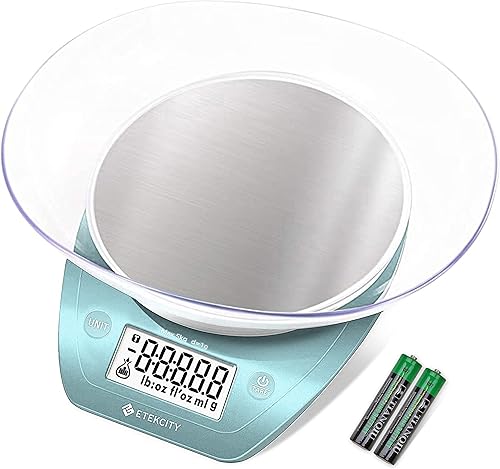
Etekcity Food Kitchen Scale with Bowl
9.7/10 our score
See it on Amazon -
2
-
3
 Best for large batches
Greater Goods Digital Food Scale for Kitchen
9.5/10 our score
See it on Amazon
- 4
 Check it
Taylor Vintage Mechanical Kitchen Scale
Best battery-free option - 5
 Check it
American Weigh Scales Precision Digital Kitchen Weight
Best for small precise loads - 6
 Check it
FOLIND Digital Kitchen Scale with Removable Bowl
Best with timer and thermometer - 7
 Check it
Weighmax Electronic Kitchen Scale
Best compact budget pick - 8
 Check it
THINKSCALE 11lb Kitchen Scale with Bowl
Best for simple baking use - 9
 Check it
Cuisinart KML-KO3B Precision Chef Bowl Electronic Kitchen
Best glass platform pick
Which kitchen scale with bowl suits dough prep best?
The Etekcity 11 lb model is the safest all-round pick for dough prep. The finer Etekcity suits small precise loads, while the Greater Goods suits large batches and the Taylor suits battery-free use.
How to read the picks below
Each write-up covers who the scale suits, what its specs mean in daily use and its trade-off. Read the badge first, then check capacity and increments against your recipes.
Etekcity Food Kitchen Scale with Bowl: Best for everyday dough prep
- 11 lb/5 kg capacity
- 0.1 oz / 1 g increments
- Detachable bowl flips over base for storage
- Tare and auto-zero
- Units in oz, lb:oz, g, mL, fl oz
An 11 lb digital scale with a detachable bowl you can mix in, then flip over the base to save space.
Pros
- Detachable bowl doubles as a cover
- Tare for weighing in your own bowl
- Multiple units including milk and water modes
Cons
- Minimum weight recommendation is 5 g
- Plastic bowl and body
This Etekcity suits home bakers who make dough at least once a week and want one scale for most jobs. Its 11 lb (5 kg) capacity holds a full dough batch plus the bowl, which covers most recipes without switching tools or doing a second weighing.
Increments are 0.1 oz / 1 g / 1 mL, with a 5 g minimum weight recommendation. That means small pinches of salt may read low, but flour, water and sugar weigh cleanly.
Unit conversion covers oz, lb:oz, g, mL and fl oz, with milk and water volume modes that make liquid weighing simpler.
The detachable bowl is the main reason it tops this list. You can mix ingredients in it, then flip it over the scale as a protective cover.
Tare and auto-zero let you use your own mug, plate or bowl instead. Against the finer Etekcity here, it trades 0.1 g resolution for a simpler 1 g step at every load.
Etekcity Food Kitchen Scale with Bowl: Best for finer precision
- 11 lb/5 kg capacity
- 0.1 g below 1000 g, 1 g above
- Detachable BPA-free bowl
- Large backlit display
- Milk and water density modes
The finer-resolution Etekcity, with 0.1 g steps for small loads and 1 g steps for large dough batches.
Pros
- 0.1 g resolution under 1 kg
- Flippable bowl for storage
- Backlit display is easy to read
Cons
- 1 g steps above 1000 g
- Plastic bowl with stainless steel base
This second Etekcity suits bakers who weigh small items like yeast, spices or coffee alongside dough ingredients. For more small-load options, compare high precision kitchen scales.
Its key difference is dual increments: 0.1 g below 1000 g and 1 g from 1000 g to 5000 g.
That finer step helps at the start of a recipe, when amounts are small.
For a 600 g flour weigh, you get finer resolution than a standard 1 g scale. For a full dough batch over 1 kg, it steps at 1 g like the others.
The minimum measurement is 1 g, and upgraded sensors are meant to give instant readings for everyday items.
Capacity is still 11 lb / 5 kg, with units in oz, lb, g, fl oz and mL, plus milk and water density modes. The detachable BPA-free bowl flips for storage and works as a cover, and the 2.4 x 1.1 in backlit display is easy to read.
Against the first Etekcity, it adds precision under 1 kg without adding capacity.
Greater Goods Digital Food Scale for Kitchen: Best for large batches
- 22 lb/10 kg capacity
- 1 g precision
- Stainless steel platform
- HOLD function up to 5 minutes
- ZERO tare function
A high-capacity 22 lb scale built for bulk flour, sourdough and large mixing bowls.
Pros
- Double the capacity of most picks
- Display extends beyond the platform
- HOLD keeps readings on screen
Cons
- No included bowl mentioned
- 1 g increments only
This Greater Goods suits batch cooks, sourdough bakers and anyone who scales recipes up for a crowd. Its 22 lb (10 kg) capacity is double most picks here, so a large mixing bowl and a full dough batch stay within range with room to add ingredients in stages.
Precision is 1 g, with units in grams, milliliters, fluid ounces, ounces, pounds and lb:oz. That step is fine for flour and water at bulk scale.
Greater Goods says it is not for laboratory or microgram measurements, which is an honest limit to keep in mind when you compare it with 0.1 g models.
The stainless steel platform and touch-sensitive controls resist stains and wipe clean. The Hi-Def LCD extends beyond the platform, so a large bowl is less likely to block the numbers.
HOLD keeps a reading for up to 5 minutes, and auto shut-off after 2 minutes saves battery. Against the others, it gives up an included bowl and finer steps to gain bulk capacity.
Taylor Vintage Mechanical Kitchen Scale: Best battery-free option
- 11 lb max capacity
- 1 oz / 50 g increments
- Spring mechanism, no batteries
- Removable dishwasher-safe bowl
- Dual-unit analog dial
A mechanical dial scale with a removable bowl, manual zero knob and no batteries to replace.
Pros
- No batteries or charging
- Dishwasher-safe bowl
- Reads in lb/oz and kg/g
Cons
- 1 oz increments are coarse for baking
- Analog dial needs close reading
This Taylor suits bakers who want a scale that is always ready with no batteries or charging. Its spring mechanism runs without power, so there are no batteries to replace and no cable to find in a drawer during prep.
Capacity is 11 lb (5 kg) in 1 oz (50 g) increments. That coarse step is the trade-off.
It handles flour, produce and large cuts of meat well, but it is less suited to precise baking where a few grams of salt or yeast matter. The listed readout accuracy is 1 oz, so small recipe changes may not show.
The dual-unit analog dial shows lb/oz and kg/g, so you can follow recipes from any source without converting units. The removable bowl lifts off for filling and pouring, and a manual zero-adjust knob tares the bowl weight.
The bowl is dishwasher safe and flips over the base. Against digital picks, it trades gram precision for battery-free simplicity and a low maintenance routine.
American Weigh Scales Precision Digital Kitchen Weight: Best for small precise loads
- 3 kg x 0.1 g capacity
- Large plastic dishwasher-safe bowl
- Counting feature
- Runs on batteries or AC adapter
- Backlight on or off
A 3 kg precision scale with a large dishwasher-safe bowl and a counting feature.
Pros
- 0.1 g resolution
- AC adapter option included
- Large bowl for loose ingredients
Cons
- 3 kg cap is low for big dough batches
- Limited specs on units and display
This American Weigh Scales model suits bakers who weigh small precision loads more than full dough batches. Its 3 kg x 0.1 g resolution is the finest stated here for small weights.
That precision helps with yeast, herbs, beads or small amounts of spice.
It will not help with a large dough batch, because 3 kg is the cap for scale plus bowl plus ingredients. Check your largest batch weight before choosing it, and remember a heavy mixing bowl uses part of that 3000 g total.
For a single loaf with a light bowl it can work, but for double batches it will limit you.
The large plastic bowl is dishwasher safe, which helps with sticky dough residue. A counting feature adds a second use beyond food.
It runs on batteries or the included AC adapter, and the backlight can be turned on or off. Against the 11 lb digital picks, it gives 0.1 g resolution and a 10 year warranty, but it gives up bulk capacity.
FOLIND Digital Kitchen Scale with Removable Bowl: Best with timer and thermometer
- 12 lb/5.5 kg capacity
- 0.1 oz / 1 g division
- 2.5L detachable stainless steel bowl
- Room temperature sensor
- Alarm timer
A 12 lb scale with a large 2.5L bowl, room temperature sensor and alarm timer.
Pros
- Largest stated bowl volume here
- Timer and temperature in one unit
- Stainless steel bowl
Cons
- Timer and temperature add controls to learn
- Readout accuracy listed as 2.86 g
This FOLIND suits bakers who like extra features in one unit for proofing and prep. Its 12 lb / 5.5 kg capacity with 0.1 oz / 1 g division covers standard dough batches.
That extra half kilogram over 5 kg models can help with a larger bowl.
The included bowl is 2.5L, the largest stated volume here, which gives more room for mixing and pouring. You can also use your own bowl or plate with tare and auto-zero.
The stainless steel bowl is detachable, so you can rinse it separately from the base and platform.
Extra functions include a room temperature sensor and alarm timer. Those can help during dough prep, when room temperature and timing matter for proofing.
A dough proofing container pairs well with this kind of setup, because you can weigh ingredients in the bowl, then move dough to a container for rising. Against simpler picks, it adds controls and a listed readout accuracy of 2.86 g, so check whether the timer and temperature are worth that added complexity.
Weighmax Electronic Kitchen Scale: Best compact budget pick
- 2 kg capacity
- 1 g / 0.1 oz accuracy
- Removable transparent bowl
- Blue backlit LCD
- Tare function
A compact 2 kg scale with a clear removable bowl for fruit, vegetables, flour and sugar.
Pros
- Clear bowl shows contents
- Compact footprint
- Scale, bowl and batteries included
Cons
- 2 kg cap limits large dough batches
- Model naming also mentions 5KG
This Weighmax suits budget-minded home cooks who need a compact scale for everyday weighing. Its 2 kg capacity with 1 g / 0.1 oz accuracy covers small baking jobs, fruit, vegetables and portion control.
That cap means a full dough batch with bowl may exceed the limit.
The removable transparent bowl is a practical plus. You can see contents through the sides, which helps when adding flour or sugar.
You can also use the scale without the bowl for flat items or small packages. The plastic bowl comes off for washing, which keeps cleanup simple.
The blue backlit LCD makes readings easier to read, and the tare button resets the display after you place a container on the platform. The included items are the scale, bowl and batteries, so it is ready to use out of the box.
Against larger picks, it trades capacity for a compact footprint and clear bowl, so it suits small loads and daily portioning more than bulk dough prep.
THINKSCALE 11lb Kitchen Scale with Bowl: Best for simple baking use
- 11 lb/5 kg capacity
- 0.1 oz / 1 g increments
- Minimum start weight 3 g
- Non-stick bowl with pouring spout
- Graduated bowl markings
An 11 lb scale with a non-stick bowl, pouring spout and graduated markings for liquids.
Pros
- Spout helps pour batter and milk
- Bowl flips up for storage
- Calibration function
Cons
- 3 g minimum start weight
- Plastic body and bowl
This THINKSCALE suits bakers who pour liquids and batters often during prep. Its 11 lb / 5 kg capacity with 0.1 oz / 1 g increments matches the standard dough-prep range.
That range covers flour, water and the bowl for most home recipes.
The bowl is non-stick with a pouring spout and graduated scale. That design helps with milk, water and melted ingredients, and the non-stick surface wipes clean of residue.
The bowl flips up for space-saving storage and can protect the scale from dust when not in use.
The minimum start weight is 3 g, so very small amounts of yeast or salt may not register at the start. That is a real limit for precision baking.
Tare zeroes out bowl weight, and a built-in calibration function supports long-term accuracy. Against the Etekcity picks, it gives a spout and graduated bowl, but it keeps the same 1 g step and adds a 3 g floor that matters for tiny ingredients.
Cuisinart KML-KO3B Precision Chef Bowl Electronic Kitchen: Best glass platform pick
- 11 lb capacity
- 1 g graduation
- Tempered glass platform
- Stainless steel bowl with gradient marks
- Add-on weight feature
A glass-platform scale with a stainless steel bowl that inverts as a protective cover.
Pros
- Glass platform wipes clean
- Add-on weight for multi-ingredient weighing
- Bowl inverts as a cover
Cons
- Readout accuracy listed as +/- 5 g
- Heavier unit at 2.8 lb
This Cuisinart suits bakers who prefer a glass platform and a stainless steel bowl. Its tempered glass platform wipes clean and can hold items directly, or you can use the included bowl for loose ingredients.
That surface suits bakers who want to weigh a bowl, a plate or a small pan without a plastic platform.
Capacity is 11 lb with 1 g graduation. The stainless steel bowl has gradient marks for liquid measuring, and it inverts as a protective cover for storage and display.
The bowl gives a more traditional look than plastic bowls in this group.
The add-on weight feature lets you weigh multiple ingredients without starting from scratch. That helps when you build a recipe step by step in one bowl.
The large LCD readout works in imperial or metric mode. Against the digital picks, it offers glass and steel, but the listed readout accuracy is +/- 5 g and the unit weighs 2.8 lb, so it is less suited to very precise small weights.
How do these scales stack up on capacity and precision?
Capacity and increment size separate this group more than any other spec. The Greater Goods leads on capacity at 22 lb, while the American Weigh Scales leads on small-load resolution at 0.1 g.
| Product | Best for | Capacity | Increments | Display | Our score |
|---|---|---|---|---|---|
| Etekcity Food Kitchen Scale with Bowl | everyday dough prep | 11 lb/5 kg | 0.1 oz / 1 g / 1 mL | LCD | 9.7 |
| Etekcity Food Kitchen Scale with Bowl | finer precision | 11 lb/5 kg | 0.1 g under 1 kg, 1 g above | Backlit LCD | 9.6 |
| Greater Goods Digital Food Scale for Kitchen | large batches | 22 lb/10 kg | 9.5 | ||
| Taylor Vintage Mechanical Kitchen Scale | battery-free option | 11 lb | 1 oz / 50 g | 9.2 | |
| American Weigh Scales Precision Digital Kitchen Weight | small precise loads | 3 kg | 9.0 | ||
| FOLIND Digital Kitchen Scale with Removable Bowl | with timer and thermometer | 12 lb/5.5 kg | 8.8 | ||
| Weighmax Electronic Kitchen Scale | compact budget pick | 2 kg | 8.6 | ||
| THINKSCALE 11lb Kitchen Scale with Bowl | simple baking use | 11 lb/5 kg | 0.1 oz / 1 g | 8.3 | |
| Cuisinart KML-KO3B Precision Chef Bowl Electronic Kitchen | glass platform pick | 11 lb | 8.1 |
How we compared these kitchen scales with bowls
We checked capacity, increments, minimum start weight, bowl material and volume, tare controls, display type, power source and storage design. We grouped the results by dough batch size and precision needs.
What the comparison does not show
Bowl volume is stated only for the FOLIND at 2.5L. For other models, judge bowl room by capacity and your own mixing bowl if you plan to tare a larger bowl.
How to use the comparison table
Start with capacity, then check increments for your smallest ingredient. After that, check bowl size, tare type and display read time under a large bowl.
How do you choose the right capacity for dough?
Most home dough fits an 11 lb (5 kg) scale with the bowl on top. Choose that size if your recipes stay at home scale.
Choose 22 lb if you make bulk batches, and choose 2 kg or 3 kg only for small loads.
When 11 lb is enough
An 11 lb scale covers flour, water, salt and yeast for a standard loaf, plus the bowl weight. The Etekcity, Taylor, THINKSCALE and Cuisinart models all sit in this range.
When you need more room
The Greater Goods at 22 lb suits double batches and large mixing bowls. Check the total weight of bowl plus ingredients, because the bowl counts against capacity.
When a smaller cap still works
The Weighmax at 2 kg and the American Weigh Scales at 3 kg suit small baking, portion control and precision loads. They are not the pick for large dough batches.
What precision do you need for baking?
For most baking, 1 g increments are enough. For yeast, salt and small spices, 0.1 g resolution helps.
Also check the minimum start weight, because some scales will not register tiny amounts.
1 g scales for everyday baking
The Etekcity 11 lb model, Greater Goods, FOLIND, Weighmax, THINKSCALE and Cuisinart all use 1 g steps in some form. That covers flour, sugar, water and most recipe amounts.
0.1 g scales for small weights
The Etekcity EK5250-style model steps at 0.1 g under 1 kg. The American Weigh Scales model resolves 0.1 g up to 3 kg.
Both help with small precise loads.
Mechanical scales and coarse steps
The Taylor steps at 1 oz (50 g). That is fine for bulk flour and produce.
It is coarse for precise baking, so pair your choice with your recipe style. If you want a fuller baking setup, our best kitchen scale for baking guide covers that angle in more detail.
How does tare help you weigh in a bowl?
Tare resets the display to zero with the empty bowl on the scale. Then each ingredient reading shows only that ingredient.
You can add flour, water and salt in the same bowl without extra cups.
Using tare with the included bowl
Place the empty included bowl on the platform, press tare or zero, then add the first ingredient. Press tare again between ingredients to reset to zero.
Using tare with your own bowl
The digital models here let you use your own mixing bowl, mug or plate. That is useful if your bowl is larger than the included one.
Our how to use a digital kitchen scale guide walks through the steps.
Manual tare on the Taylor
The Taylor uses a manual zero-adjust knob instead of a digital tare button. Turn the knob until the dial reads zero with the bowl on the scale.
Which bowl design works best for dough prep?
A detachable bowl that flips over the base saves storage space and protects the platform. A large bowl volume helps with mixing, while a spout and graduated marks help with liquids.
Flip-over bowls for small kitchens
The Etekcity models, Taylor, THINKSCALE and Cuisinart all use a bowl that inverts or flips as a cover. That cuts storage height and keeps dust off the platform.
Large and clear bowls
The FOLIND bowl is 2.5L. The Weighmax bowl is transparent, so you can see contents.
The American Weigh Scales bowl is large, plastic and dishwasher safe.
Spouts and graduated marks
The THINKSCALE bowl has a pouring spout and graduated scale. The Cuisinart bowl has gradient marks.
Both help when you measure milk or water by volume. For proofing after weighing, see our dough proofing container guide.
Digital, mechanical, rechargeable or dual platform: which type fits?
Digital scales give gram precision and unit conversion. Mechanical scales need no power.
Rechargeable and dual platform designs solve different storage and weighing problems.
Digital scales for precision and units
Most picks here are digital, with tare, auto-zero, backlight displays and unit conversion. If you want that full digital feature set, our best kitchen scale rechargeable guide covers power options.
Mechanical scales for battery-free use
The Taylor is the only mechanical pick here. It suits buyers who want no batteries, no charging and a simple dial.
It trades precision for that simplicity.
Dual platform and small scales
A dual platform design adds a second weighing surface for some jobs. If that matters to you, our best dual platform kitchen scale guide compares those models.
For tight counters, our best small kitchen scale guide covers compact footprints.
Taylor models for brand fans
If you prefer Taylor dial scales, our best taylor digital kitchen scale guide covers that brand line. The Taylor mechanical model here is the battery-free option in this roundup.
How do you set up and care for a scale with a bowl?
Set the scale on a flat, stable surface before you weigh. A wobbly counter can shift readings, especially at 1 g or 0.1 g steps.
Set-up steps for dough weighing
Place the scale on a level surface, add the empty bowl, press tare, then add ingredients. Keep the display clear of flour so you can read each step.
Cleaning the bowl and platform
Wash the bowl by hand or in the dishwasher where the specs allow it. The Taylor and American Weigh Scales bowls are dishwasher safe.
Wipe the platform with a damp cloth and dry it fully.
Storage and battery care
Flip the bowl over the base where the design allows it, and store the scale in a cabinet. Replace batteries when the display fades, and keep the scale away from water on the electronics.
Which scale should you buy for dough prep?
Pick the Etekcity 11 lb model if you want the best all-round match for dough prep. Pick the Greater Goods if batch size is your main concern, and pick the Taylor if battery-free use matters most.
For small precise loads, pick the American Weigh Scales or the finer Etekcity. For a large included bowl and timer features, pick the FOLIND.
For easy pouring, pick the THINKSCALE. For a glass platform, pick the Cuisinart.
If you pair your scale with a stand mixer for dough, our best stand mixers for baking guide can help you plan the rest of your setup. Then weigh, tare the bowl, add ingredients in order, and keep the scale in a flat spot where you can read it at a glance.
That is the simple rule for the best kitchen scale with bowl: match capacity to your largest batch, match precision to your smallest ingredient, and choose a bowl design you will actually wash and store.
Our top 3 picks at a glance
-
1
Best for everyday dough prep
Etekcity Food Kitchen Scale with Bowl
9.7/10 our score
See it on Amazon -
2
-
3
Best for large batches
Greater Goods Digital Food Scale for Kitchen
9.5/10 our score
See it on Amazon
Frequently asked questions
What capacity do I need in a kitchen scale with bowl for dough?
For most home dough, 11 lb (5 kg) covers flour, water and the bowl with room to spare. Choose 22 lb if you scale recipes for large batches or family gatherings.
A 2 kg or 3 kg scale suits small portions better than full dough batches.
Should I weigh dough ingredients in the bowl or on the platform?
Use the bowl for loose ingredients like flour, sugar and water. Place the empty bowl on the scale, press tare or zero, then add ingredients.
That way the reading shows only the ingredient weight, not the bowl.
What precision do I need for baking with a digital kitchen scale with bowl?
For baking, 1 g increments work for most recipes. If you weigh yeast, salt or coffee in small amounts, 0.1 g resolution helps.
Check the minimum start weight too, because very small amounts may not register on some scales.
Can I use my own mixing bowl on these scales?
Yes, on the digital models with tare or zero. Set your empty bowl on the platform, reset the display to zero, and weigh into it.
Make sure the bowl base sits flat and does not hang over the edges.
How do I store a kitchen scale with bowl in a small kitchen?
Look for a bowl that flips over the base as a cover. That design protects the platform and cuts storage height.
The Etekcity, Taylor, THINKSCALE and Cuisinart models in this guide all use that idea in some form.


